
All current affairs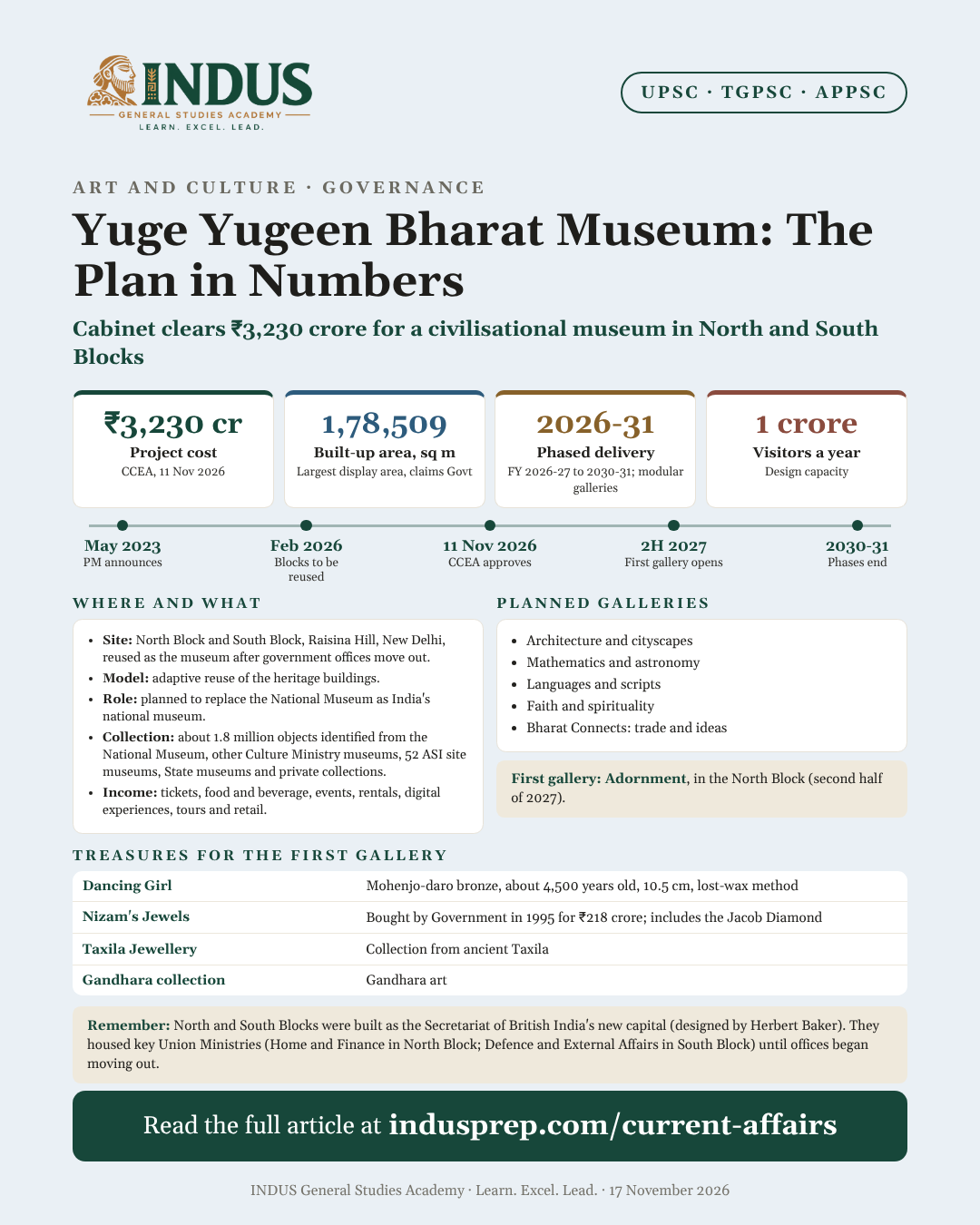
National
Yuge Yugeen Bharat Museum: Cabinet Clears ₹3,230 Crore for a Civilisational Museum
In news
- The CCEA, chaired by PM Narendra Modi, approved the Yuge Yugeen Bharat Museum (YYBM) on 11 November 2026 at a total cost of ₹3,230 crore, as appraised by the Public Investment Board.
- It will be built by adaptive reuse of the North Block and South Block complex in New Delhi, after government offices move out.
- The Dancing Girl of Mohenjo-daro, the Nizam's Jewels, the Taxila Jewellery collection and the Gandhara collection are to be shown in the first gallery.
Key facts
- Announced: by PM Modi on 18 May 2023.
- Built-up area: about 1,78,509 sq m. The Government says it will have the largest display area of any museum in the world.
- Implementation: in phases from 2026-27 to 2030-31. The design is modular, so galleries are added in phases.
- First gallery: Adornment, in the North Block, expected in the second half of 2027.
- Other planned galleries: architecture and cityscapes; mathematics and astronomy; languages and scripts; faith and spirituality; and Bharat Connects, on India's links with the world through trade and ideas.
- Collection: about 1.8 million objects identified from the National Museum, other Culture Ministry museums, 52 ASI site museums, State museums and private collections. Content analysis is under way.
- Capacity: designed for about 1 crore visitors a year.
- Income: ticket sales, food and beverage, events, venue rentals, digital experiences, guided tours and retail.
- It is planned to replace the National Museum as India's national museum.
The first-gallery treasures
- Dancing Girl: a bronze figure from Mohenjo-daro, about 4,500 years old and only 10.5 cm tall. It is made by the lost-wax method, one of the earliest examples of this technique. The museum describes her with 24 bangles on one arm and four on the other. She was found in 1926. It is a Harappan (Indus Valley) find now in the National Museum, Delhi.
- Nizam's Jewels: the collection of the last Nizam of Hyderabad, bought by the Government of India in 1995 for ₹218 crore. Its centrepiece is the Jacob (Imperial) Diamond. Telangana angle for TGPSC.
- Taxila and Gandhara collections: Taxila (Takshashila) was a major centre of learning and trade. Gandhara art blended Greco-Roman and Indian styles and is known for Buddha images.
Why North and South Blocks?
- They were built to house the Secretariat of British India's new capital, New Delhi, and were designed by Herbert Baker. Until now they have housed key Ministries such as Home, Finance, Defence and External Affairs.
- Ministries are moving to the Common Central Secretariat under the Central Vista redevelopment. Reusing the blocks keeps the heritage buildings in public use.
Concerns
- In September 2026 the Dancing Girl was moved to the Jewellery Gallery to make room for a mock gallery of the new museum. Former MP R. Senthil wrote to the Culture Minister demanding that it be restored to the Indus Valley Gallery.
- Several other prominent artefacts removed from the National Museum's displays have not been put back.
Static connect
- Indus Valley Civilisation: about 2600 to 1900 BCE (mature phase). Mohenjo-daro is on the Indus in Sindh (now Pakistan).
- Museums: The National Museum, New Delhi (collection from 1949) moved to its present building in 1960. The Indian Museum, Kolkata (1814) is India's oldest. Salar Jung Museum, Hyderabad is among the largest one-man collections.
- Central Vista: includes the new Parliament building, Kartavya Path, and the Common Central Secretariat.
Exam relevance: GS-1 (Art and Culture, Indus Valley Civilisation), GS-2 (Government policies); TGPSC and APPSC Groups (History, Culture, Current Affairs).
Get the full month in one PDF
The Current Affairs Monthly covers every important item in English and Telugu, with Group 1 points.
Browse current affairs material