
All current affairs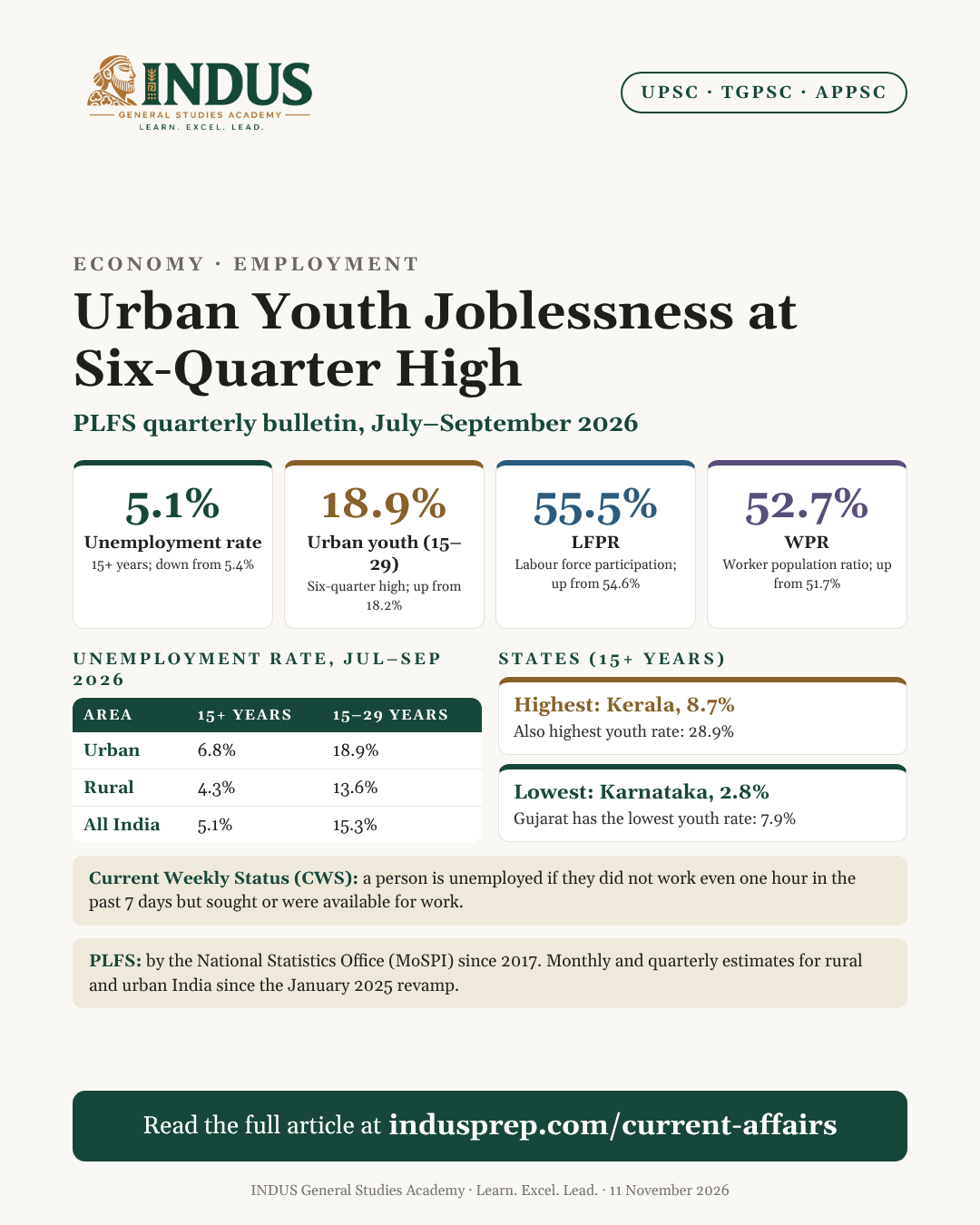
National
Urban Youth Unemployment Hits Six-Quarter High of 18.9%: PLFS July–September 2026
In news
- The National Statistics Office (NSO) released the Periodic Labour Force Survey (PLFS) quarterly bulletin for July–September 2026 (Q2 of 2026-27) on 10 November.
- Unemployment among urban youth (15–29 years) rose to 18.9%, a six-quarter high, from 18.2% in the previous quarter.
- The overall unemployment rate (15 years and above) fell to 5.1% from 5.4%.
Key findings
Youth (15–29 years)
- Urban young women: unemployment rose to over 26%, a six-quarter high.
- Urban young men: 16.5%, also a six-quarter high.
- Rural youth: fell from 14.7% to 13.6%. So the combined youth rate eased to 15.3% from 15.9%.
All persons (15 years and above)
- Rural unemployment fell to 4.3% from 4.8%.
- Urban unemployment rose to 6.8%, a four-quarter high.
- Labour Force Participation Rate (LFPR) rose to 55.5% from 54.6%.
- Worker Population Ratio (WPR) rose to 52.7% from 51.7%.
Nature of jobs
- Casual labour fell to a six-quarter low of 18.4% of workers.
- Rural areas: the share of self-employed rose to 62.7%.
- Urban areas: regular wage and salaried jobs rose slightly to 49.6%.
- Agriculture's share of all workers rose to 41.7% from 38.7%. This is a seasonal kharif effect: farm work peaks in July–September.
States
- Highest unemployment: Kerala (8.7%), followed by Punjab and Andhra Pradesh (7.8% each).
- Lowest: Karnataka (2.8%), Gujarat (3.2%) and West Bengal (3.4%).
- Youth unemployment was highest in Kerala (28.9%) and lowest in Gujarat (7.9%).
What the numbers mean
- Two-speed labour market: rural jobs improve with the farm season, while urban youth find it harder to get work.
- Educated unemployment: urban youth often seek formal, salaried jobs. They are more likely to wait for the right job than take casual work.
- Gender gap: urban young women face the highest unemployment, even as female participation slowly rises.
- Skills mismatch: what colleges teach does not always match what employers want.
- Shift to agriculture in Q2 shows that farming still absorbs labour when other jobs are scarce. Productivity there is low.
Steps by the government
- Pradhan Mantri Viksit Bharat Rozgar Yojana (the Employment Linked Incentive scheme): incentives to employers for new jobs and to first-time employees.
- PM Internship Scheme: internships in top companies for youth aged 21–24.
- Skill India Mission and PM Kaushal Vikas Yojana for job-ready skills.
- Production Linked Incentive (PLI) schemes and MSME support to grow manufacturing jobs.
Way forward
- Grow labour-intensive manufacturing, such as textiles, food processing, leather and electronics assembly.
- Link education with industry through apprenticeships and industry-designed courses.
- Raise women's participation through safe transport, childcare and flexible work.
- Support urban employment schemes and services-sector jobs in tier-2 and tier-3 cities.
Static connect
- PLFS: launched by the NSO in April 2017. The NSO was formed in 2019 by merging the CSO and the NSSO under MoSPI.
- January 2025 revamp: monthly and quarterly estimates for both rural and urban India under CWS. Earlier quarterly bulletins covered only urban areas.
- Current Weekly Status (CWS): activity in the last 7 days. Usual Status (ps+ss): activity over the last 365 days.
- LFPR: share of the population that is working or seeking work.
- WPR: share of the population that is employed.
- Unemployment Rate: share of the labour force that is unemployed.
Exam relevance: UPSC Prelims and GS-3 (Indian Economy, Employment, Inclusive growth); TGPSC and APPSC Groups (Indian Economy).
Get the full month in one PDF
The Current Affairs Monthly covers every important item in English and Telugu, with Group 1 points.
Browse current affairs material