
All current affairs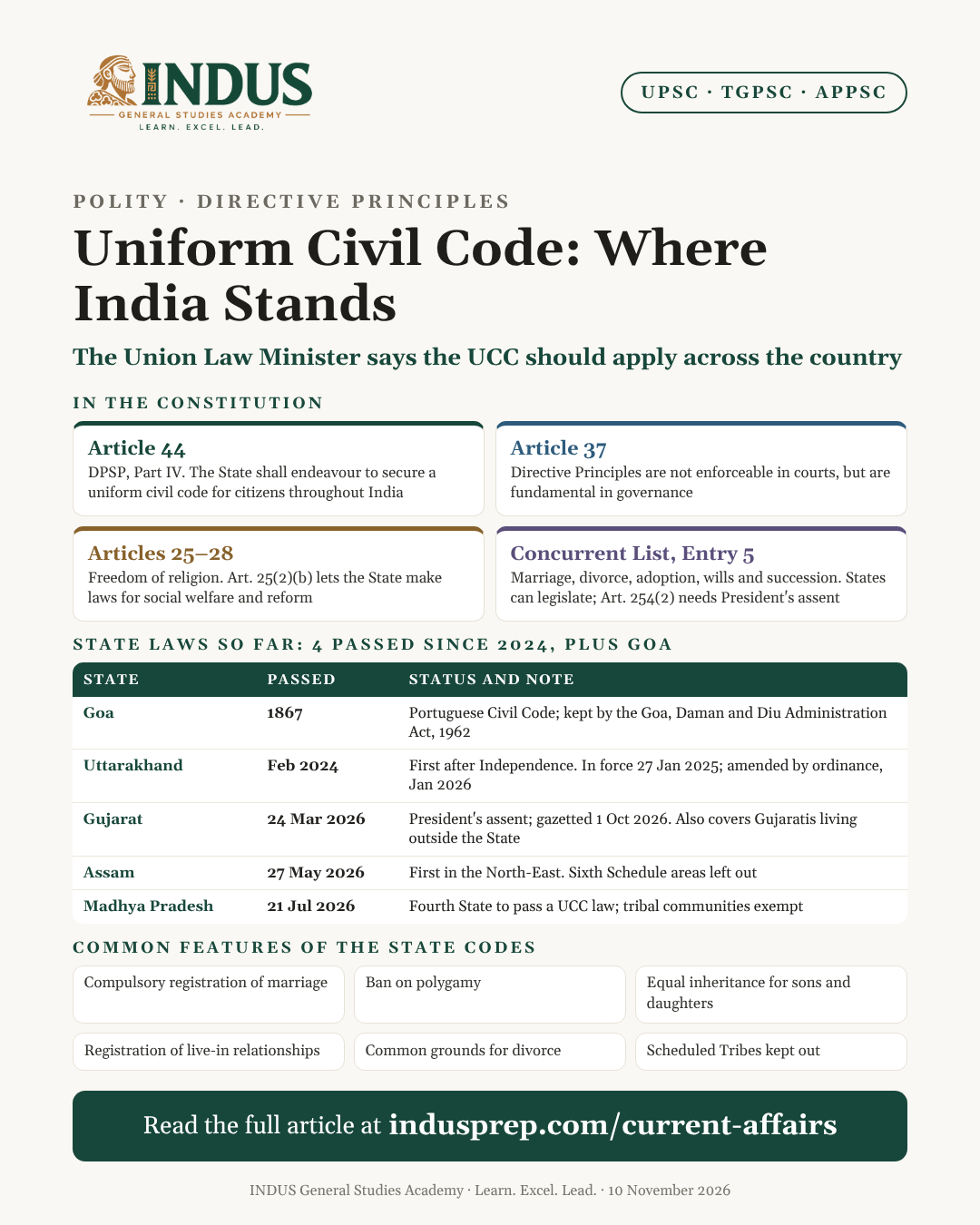
National
Uniform Civil Code Should Apply Across India, Says Law Minister: Where the UCC Stands
In news
- Arjun Ram Meghwal, Union Minister of State (Independent Charge) for Law and Justice, said the Centre is committed to a Uniform Civil Code (UCC) across the country.
- He said the UCC has a constitutional basis in Article 44, so there is no reason to restrict it to a few States.
- He cited the Constituent Assembly debates, repeated Supreme Court observations and Goa's long-standing common civil code.
- Union Home Minister Amit Shah has earlier said the UCC would be in place in all 21 BJP- and NDA-ruled States before 2029.
What is a Uniform Civil Code?
- A UCC is one set of civil laws for all citizens, whatever their religion.
- It covers marriage, divorce, maintenance, adoption, guardianship, inheritance and succession.
- Today these matters are governed largely by religion-based personal laws:
- Hindus, Sikhs, Jains and Buddhists: Hindu Marriage Act, 1955; Hindu Succession Act, 1956 and related Acts.
- Muslims: Muslim Personal Law (Shariat) Application Act, 1937, and uncodified law.
- Christians: Indian Christian Marriage Act, 1872; Indian Divorce Act, 1869.
- Parsis: Parsi Marriage and Divorce Act, 1936.
- Criminal law is already uniform (Bharatiya Nyaya Sanhita, 2023). So are contract and evidence law.
- The Special Marriage Act, 1954 offers an optional civil marriage for any two persons, whatever their religion.
The Constituent Assembly debate
- The UCC was Article 35 of the Draft Constitution. It became Article 44.
- Members Minoo Masani, Hansa Mehta and Rajkumari Amrit Kaur wanted it as a Fundamental Right. The sub-committee placed it among the Directive Principles instead.
- Some members, such as Mohammad Ismail, sought to protect personal laws.
- Dr. B.R. Ambedkar defended the clause. He suggested the code could at first apply only to those who chose it.
The State route
- Marriage, divorce, adoption and succession are in Entry 5 of the Concurrent List. So States can make their own UCC laws.
- A State law that conflicts with a central law needs the President's assent under Article 254(2) to prevail in that State.
- Uttarakhand was first after Independence. Its Act was passed in February 2024 and has been in force since 27 January 2025.
- Gujarat (March 2026), Assam (May 2026) and Madhya Pradesh (July 2026) followed.
- Scheduled Tribes are kept out of every State code, to protect their customary laws.
Key features of the State codes
- Marriage: compulsory registration and a ban on polygamy. Uttarakhand fixes the minimum age at 21 for men and 18 for women.
- Divorce: the same grounds for all, such as cruelty, desertion, adultery and conversion. Divorce must go through a court.
- Inheritance: equal shares for sons and daughters.
- Live-in relationships: must be registered. In Uttarakhand, a child born in such a relationship is a legitimate child.
- Practices ended: Uttarakhand's code bans nikah halala and iddat; Madhya Pradesh's code makes triple talaq and nikah halala offences.
- Uttarakhand's 2026 ordinance (under Article 213) aligned the penal provisions with the new criminal laws and tightened rules on fraud and coercion in registration.
The debate
Arguments for a UCC
- Gender justice: personal laws often treat women unequally in divorce, maintenance and inheritance.
- Equality and secularism: one law for all citizens fits Article 14.
- National integration and simpler law: fewer overlapping codes and fewer conflicts.
- Goa shows that a common code can work in a diverse society.
Concerns raised
- Religious freedom under Articles 25 to 28 and cultural rights under Article 29.
- Diversity: customary laws of tribal communities and Sixth Schedule areas. Protections under Articles 371A and 371G for Nagaland and Mizoram.
- Uniformity versus exemptions: codes that exempt Scheduled Tribes are not fully uniform.
- Privacy: compulsory registration of live-in relationships may conflict with the right to privacy (Puttaswamy, 2017).
- The 21st Law Commission (2018) preferred reforming each family law to a single code at that stage.
Way forward
- Wide consultation with communities, women's groups and States.
- Step-by-step reform: begin with common ground such as marriage registration, minimum age and equal inheritance.
- Gender justice first: the test of any code is whether it ends discrimination.
- Protect diversity where the Constitution provides for it, such as tribal customary law.
Static connect
- Article 44 (DPSP): "The State shall endeavour to secure for the citizens a uniform civil code throughout the territory of India."
- Article 37: Directive Principles are not enforceable by courts but are fundamental in the governance of the country.
- Article 51A(e): fundamental duty to renounce practices derogatory to the dignity of women.
- Muslim Women (Protection of Rights on Marriage) Act, 2019: made instant triple talaq a punishable offence.
- Goa: follows the Portuguese Civil Code of 1867, continued after Goa's liberation in 1961.
Exam relevance: UPSC Prelims and GS-2 (Polity, DPSP, Fundamental Rights, Federalism); GS-1 (Society, Women); TGPSC and APPSC Groups (Indian Polity).
Get the full month in one PDF
The Current Affairs Monthly covers every important item in English and Telugu, with Group 1 points.
Browse current affairs material