
Mains Corner
Transgender Persons Amendment Act, 2026: Rights, Recognition and Access to Healthcare
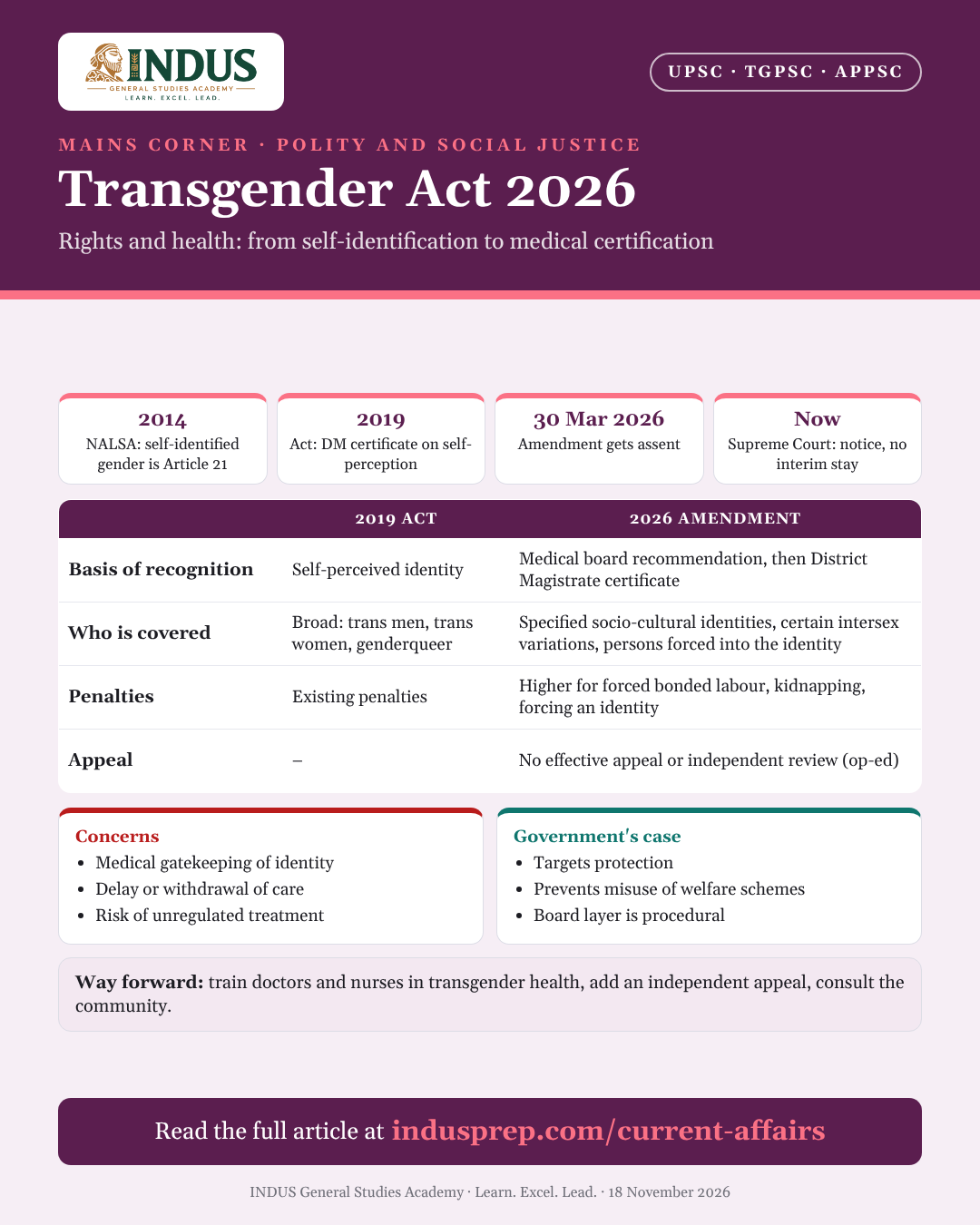
GS mapping: GS-2 (Vulnerable sections, Welfare laws, Judiciary) | GS-4 (Dignity, autonomy, equity) | GS-1 (Social empowerment) | Essay
Why in news: A Hindu op-ed (18 November 2026) by physicians, public health practitioners and activists argues that the Transgender Persons (Protection of Rights) Amendment Act, 2026 compromises transgender rights and healthcare, and that doctors, nurses and hospital administrators need training in basic transgender health.
Background
- NALSA v. Union of India (2014): the Supreme Court recognised self-identified gender as part of personal autonomy and dignity under Article 21, and recognised transgender persons as a third gender entitled to equality.
- Transgender Persons (Protection of Rights) Act, 2019: a person could apply to the District Magistrate (DM) for a certificate of identity based on self-perceived identity.
- Amendment Act, 2026: introduced in the Lok Sabha on 13 March 2026, passed by Parliament on 24-25 March by voice vote amid an opposition walkout, and received Presidential assent on 30 March 2026. A motion to refer it to a Select Committee was rejected.
What the 2026 Amendment changes
- Self-identification removed: the DM issues the certificate only after examining the recommendation of a designated medical board headed by a Chief Medical Officer or Deputy Chief Medical Officer.
- Narrower definition: it recognises specified socio-cultural identities (such as kinner, hijra, aravani, jogta), certain intersex variations, and persons forced to assume a transgender identity. The op-ed says trans men, trans women and genderqueer persons fall outside it.
- Penalties: higher punishment for forcing transgender persons into bonded labour, kidnapping or a transgender identity.
- Name change: first names in official documents can change after certification.
The case made by the op-ed authors
- Medicalisation: it makes a medical authority the gatekeeper of gender identity, reviving a psychiatric model that the Supreme Court had rejected.
- Conflict with international guidance: the definition contradicts WHO ICD-11 and the WPATH Standards of Care, Version 8.
- No appeal: the Act has no effective appeal mechanism or independent review, though the certificate decides access to rights and schemes.
- Barriers to care: ambiguity on the legality of gender-affirming care has led some providers to delay, suspend or withdraw services.
- Grey market: people may turn to unregulated providers, raising the risk of self-medication, infection and complications.
- Wider exclusion: barriers to documentation, employment, education, social security, insurance and mental health services.
- Clinical gap: clinical understanding of transgender health needs remains rudimentary; staff need basic training.
The case for the Amendment
- The Government argued that the changes target protections at those who need them and prevent misuse of welfare schemes.
- It says the medical-board layer is procedural, not registration, and that the underlying right to recognition survives.
- Supporters also point to the stronger penalties against forced transgender identity and trafficking-type offences.
Where it stands
- Petitions challenge the Act under Articles 14, 15, 19 and 21, led by Laxmi Narayan Tripathi and Zainab Patel.
- The Supreme Court issued notice to the Union and declined an interim stay.
- Two members of the National Council for Transgender Persons resigned when the Rajya Sabha passed the Bill, and a Supreme Court-appointed expert committee had recommended withdrawing it for further consultation.
- Reports differ on whether the Act has been formally brought into force (one report says 25 May 2026). Check the notification before quoting a date.
Way forward
- Training: include transgender health in MBBS, nursing and hospital administration curricula.
- Safeguards: time-bound board decisions, written reasons and an independent appeal.
- Care access: clear guidance that gender-affirming and supportive care remains lawful.
- Consultation: involve the community and the National Council for Transgender Persons in rules and design.
- Health coverage: link to the Ayushman Bharat transgender health package and make it usable without documentation delays.
Conclusion
The central question is whether the State protects a marginalised group by adding verification, or by maximising autonomy with strong safeguards against exploitation. Either way, healthcare access should not wait on certification.
Practice questions
- "The Transgender Persons (Protection of Rights) Amendment Act, 2026 shifts the basis of legal recognition from autonomy to medical assessment." Examine its implications for rights and access to healthcare. (15 marks, 250 words)
- Discuss how far the 2026 Amendment is consistent with the NALSA judgment (2014). (10 marks, 150 words)
Exam relevance: GS-2 and GS-4 (Mains); Prelims (NALSA 2014, 2019 Act, Articles 14, 15, 19, 21); TGPSC and APPSC Groups (Polity, Social Issues).
Get the full month in one PDF
The Current Affairs Monthly covers every important item in English and Telugu, with Group 1 points.
Browse current affairs material