
Mains Corner
Title: The Ganga Water Treaty Expires on 12 December. What Should Replace It?
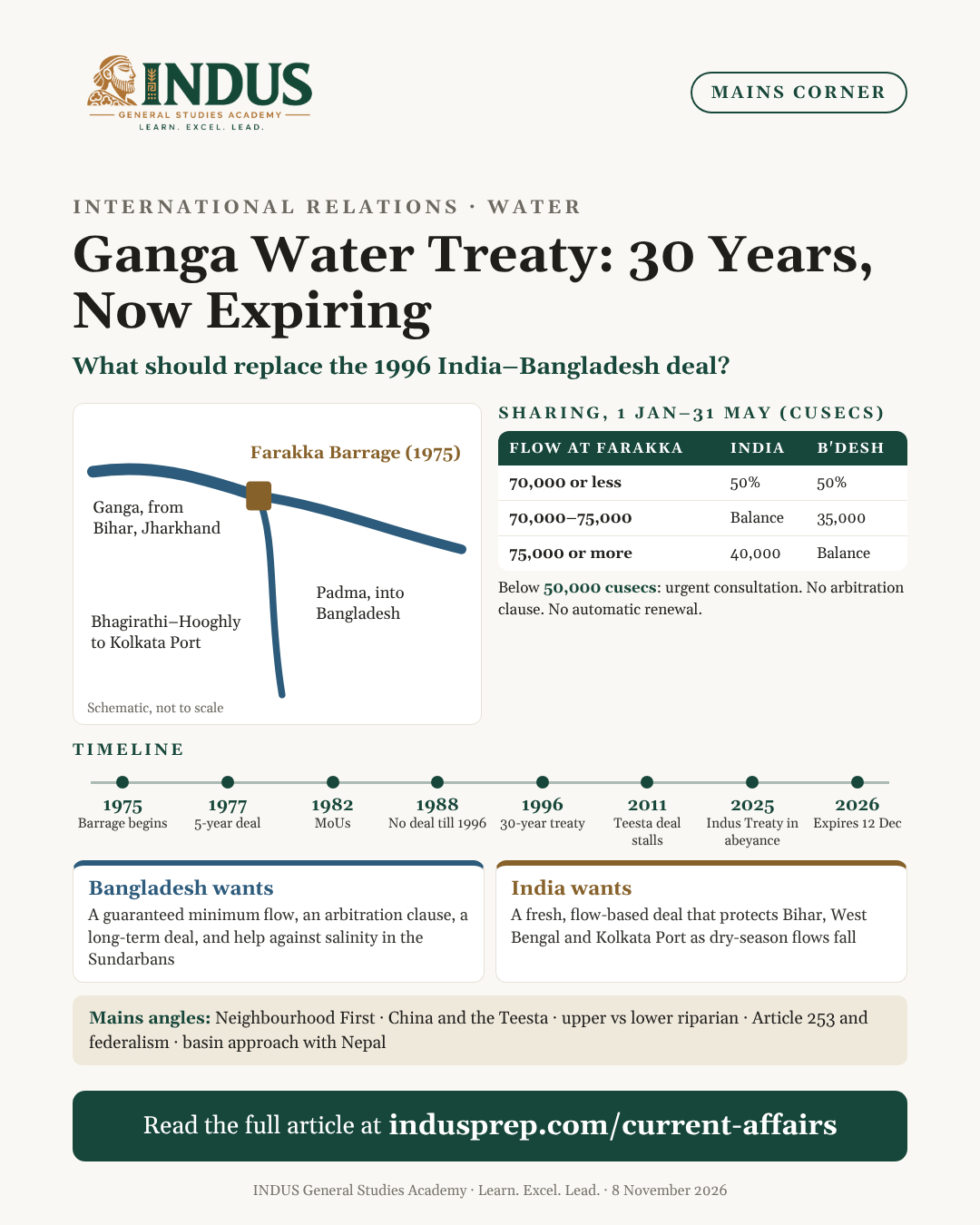
GS mapping: GS-2 (India and its neighbourhood, Bilateral agreements, Federalism) | GS-1 (Drainage systems, Distribution of water resources) | GS-3 (Water security, Environment) | Essay
Why in news: The Ganga (Ganges) Water Treaty between India and Bangladesh, signed on 12 December 1996 for 30 years, expires on 12 December 2026. The MEA says talks continue through the Joint Rivers Commission, but no renewal has been announced. Bangladesh's government under Prime Minister Tarique Rahman has called renewal a test of the relationship. In India, an important coalition partner, the JD(U), wants fresh negotiations. An Indian parliamentary panel urged the government in August 2026 to begin renewal talks without delay.
The river and the barrage
- The Ganga enters West Bengal from Jharkhand. At Farakka (Murshidabad district), a barrage diverts part of its flow into the Bhagirathi–Hooghly, which flows south past Kolkata.
- The main stream flows on into Bangladesh, where it is called the Padma. It later joins the Brahmaputra (Jamuna) and the Meghna before reaching the Bay of Bengal.
- Farakka Barrage was commissioned in 1975. Its purpose is to push enough water down the Hooghly to flush silt and keep Kolkata Port navigable.
- The core problem: in the dry season (January to May), flows are low. Every cusec that India diverts at Farakka is a cusec that does not reach Bangladesh.
How the dispute was handled
| Year | Arrangement |
|---|---|
| 1975 | Farakka Barrage commissioned; a short-term sharing arrangement for its trial run |
| 1976 | Bangladesh raised the issue at the UN General Assembly |
| 1977 | Five-year agreement, with a clause that Bangladesh would get at least 80% of its scheduled share in low flows. Bangladesh sees this as a "guarantee clause" |
| 1982, 1985 | Short-term MoUs; the guarantee clause was dropped |
| 1988–1996 | No agreement for eight years |
| 1996 | Ganga Water Treaty signed by PMs H. D. Deve Gowda and Sheikh Hasina, for 30 years. West Bengal CM Jyoti Basu played a key role |
What the 1996 treaty provides
- Sharing period: 1 January to 31 May each year, in 10-day blocks, measured at Farakka.
| Flow at Farakka | India | Bangladesh |
|---|---|---|
| 70,000 cusecs or less | 50% | 50% |
| 70,000–75,000 cusecs | The balance | 35,000 cusecs |
| 75,000 cusecs or more | 40,000 cusecs | The balance |
- Lean-season assurance: from 11 March to 10 May, each country is assured 35,000 cusecs in alternate 10-day periods.
- Emergency clause: if the flow falls below 50,000 cusecs in any 10-day period, the two governments must consult immediately. Adjustments are to follow equity, fair play and no harm to either party.
- Monitoring: a Joint Committee records daily flows at Farakka and at Hardinge Bridge in Bangladesh. Unresolved issues go to the Joint Rivers Commission (JRC), set up in 1972.
- Renewal: by mutual consent only. There is no automatic extension and no arbitration clause.
What each side wants now
Bangladesh
- A long-term treaty with a guaranteed minimum flow, like the 1977 clause.
- An arbitration or dispute-resolution clause.
- Attention to downstream harm: the Gorai distributary drying up, salinity moving inland into the Sundarbans, and losses to farming, fisheries and navigation.
- Help with the long-delayed Ganges (Padma) Barrage inside Bangladesh, to store water for the dry months.
India
- No automatic extension on old terms. A fresh deal must reflect present-day flows and needs.
- Sharing based on actual river flow, since dry-season flows at Farakka have fallen because of upstream use and changing rainfall.
- Protection for Bihar and West Bengal: drinking water, irrigation and the health of Kolkata Port.
- Bihar's concern: silt trapped by the barrage is blamed for floods and river-bed rise upstream.
Why this treaty matters beyond water
- Neighbourhood First: Bangladesh is India's largest trading partner in South Asia and shares its longest land border (about 4,096 km). A water dispute can spoil ties in trade, connectivity and security.
- The China factor: China has offered to fund the Teesta River project in Bangladesh. It is also building a giant dam on the Yarlung Tsangpo (Brahmaputra) in Tibet. If India seems inflexible, Beijing gains space in Dhaka.
- India as both upper and lower riparian: India is upstream of Bangladesh and Pakistan, but downstream of China on the Brahmaputra. In April 2025, India put the Indus Waters Treaty in abeyance after the Pahalgam attack. How India treats Bangladesh will shape how others judge its arguments with China.
- Federalism: water is a State subject (Entry 17, State List), but foreign treaties are a Union matter. Under Article 253, Parliament can make laws to implement treaties. In practice, the Centre needs the support of riparian States. The Teesta deal (2011) stalled because West Bengal objected.
- Ecology: the Sundarbans, a UNESCO World Heritage Site shared by both countries, depends on fresh water to hold back salinity.
Challenges in negotiating a new treaty
- Less water to share: upstream withdrawals in Uttar Pradesh and Bihar, groundwater use and climate change have reduced dry-season flows.
- Old data: the 1996 formula is based on flow records from 1949–1988. It may not reflect today's river.
- Domestic politics on both sides: coalition pressures in India and the political weight of the issue in Bangladesh.
- No basin approach: Nepal, where much of the Ganga's dry-season flow originates, is not part of the treaty.
- Linked disputes: the Teesta, India's share of 54 common rivers, and border issues are all tied up with the Ganga talks.
Way forward
- Avoid a legal vacuum: agree on an interim extension if a new treaty is not ready by 12 December.
- Update the science: joint study of current flows, silt and climate projections, with real-time data sharing.
- Flexible, flow-based sharing: fair shares in bad years, with a clear trigger for consultation and an agreed dispute-resolution step.
- Basin-level cooperation: bring in Nepal for storage on tributaries such as the Kosi and Gandak, which can raise lean-season flows for all three countries.
- Take States along: formal consultation with Bihar and West Bengal before and during talks.
- Package diplomacy: link water with energy trade, connectivity and Sundarbans conservation, and settle the Teesta issue.
- Use global principles: equitable and reasonable use and no significant harm, as in the Helsinki Rules (1966) and the UN Watercourses Convention (1997). India is not a party to the 1997 convention, but these principles have shaped its treaties.
Connect the dots
| Related theme | The connection |
|---|---|
| Indus Waters Treaty (1960) | India's other major water treaty, placed in abeyance in 2025; it shows that water treaties are now tied to wider relations |
| Mahakali Treaty (1996) | Signed with Nepal in the same year; shows the value of benefit-sharing projects |
| Teesta dispute | Interim deal agreed in 2011 but unsigned; Centre–State friction in foreign policy |
| Brahmaputra and China | No water treaty with China; only data-sharing MoUs for the flood season |
| Inter-State river disputes | The same issues of fair shares arise within India, for example in the Krishna and Godavari basins; Article 262 covers these |
| Climate change | Glacier melt and erratic monsoons make fixed formulas risky |
| Neighbourhood First and BBIN | Water is central to sub-regional cooperation among Bangladesh, Bhutan, India and Nepal |
Conclusion
The Ganga Water Treaty kept the peace on a hard issue for 30 years. Its lesson is that water sharing works when politics and trust align. A new deal must be fair to Bangladesh downstream, protect the needs of Bihar and West Bengal, and adjust to a river that now carries less water in the dry season. If India settles it with generosity and good science, it strengthens its claim to be a responsible regional power, including in its own talks with China over the Brahmaputra.
Mains toolkit
Keywords for answers: upper and lower riparian, lean-season flow, guarantee clause, equitable and reasonable utilisation, no significant harm, basin approach, hydro-diplomacy, Neighbourhood First, cooperative federalism, Article 253, salinity ingress, Joint Rivers Commission
Practice questions
- The Ganga Water Treaty of 1996 is due to expire in December 2026. Discuss the key issues that India and Bangladesh must address in a new water-sharing agreement. (150 words, 10 marks)
- "India's approach to shared rivers must be consistent, whether it is the upper or the lower riparian." Examine this statement in the context of the Ganga, Indus and Brahmaputra rivers. (250 words, 15 marks)
Get the full month in one PDF
The Current Affairs Monthly covers every important item in English and Telugu, with Group 1 points.
Browse current affairs material