
All current affairs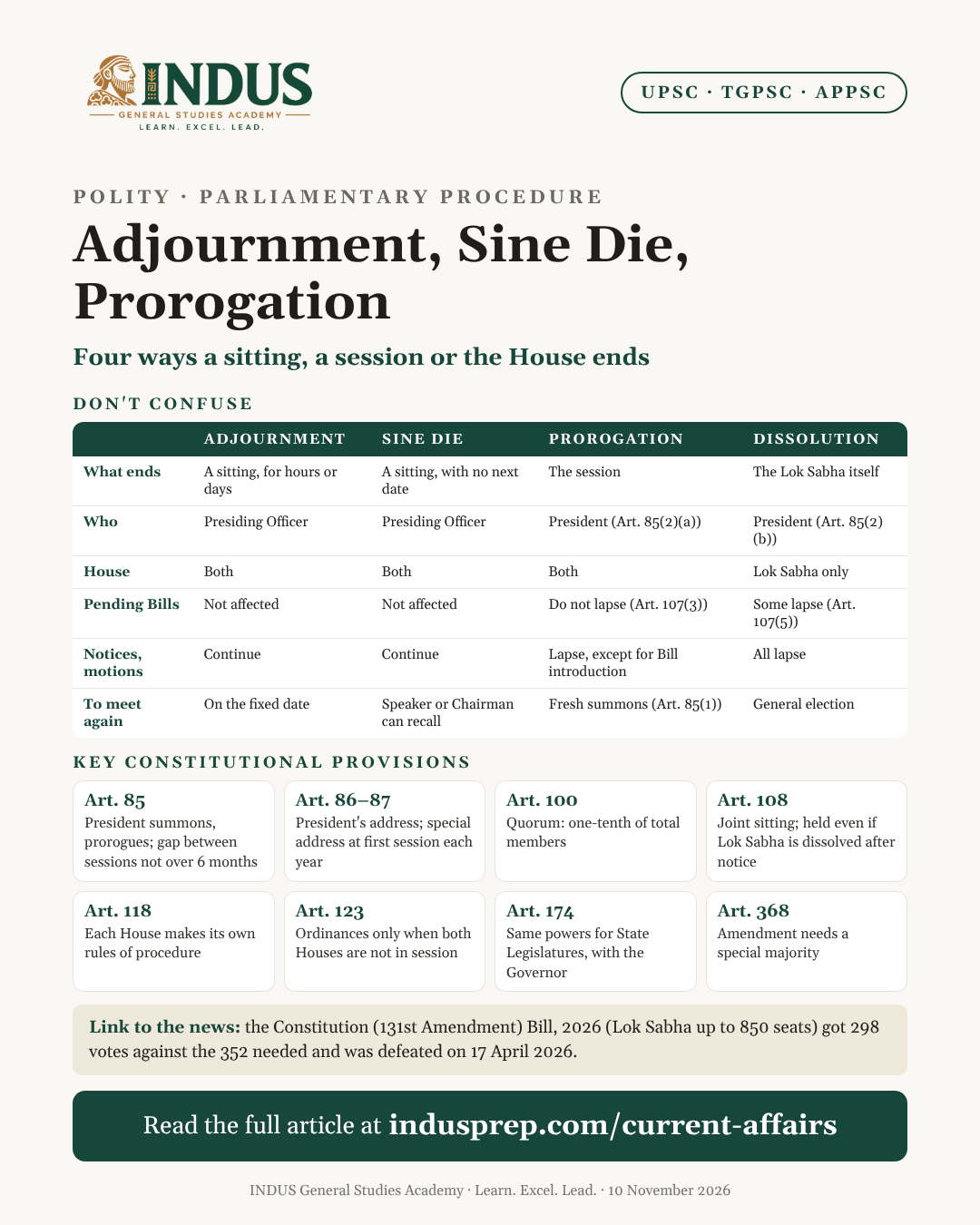
National
Monsoon Session Stays Unprorogued for a Record 88 Days: Prorogation Explained
In news
- Parliament's Monsoon Session 2026 had not been prorogued for 88 days as of 9 November 2026.
- Both Houses were adjourned sine die on 13 August 2026. Normally, prorogation follows within 3 to 4 days.
- The earlier longest gap was 28 days, in 2015. In 2008, a session was kept alive for 87 days and the House was recalled twice.
- There is speculation that the House may be called back to take up the constitutional amendment on delimitation linked to women's reservation.
The 2026 Monsoon Session at a glance
- Held from 20 July to 13 August 2026, with 19 sittings.
- Low functioning: Lok Sabha worked for about 15% and Rajya Sabha for about 33% of scheduled time (PRS Legislative Research).
- 12 Bills were passed, including the Public Examinations (Prevention of Unfair Means) Amendment Bill, 2026.
- Question Hour in the Lok Sabha ran for just about 1% of its scheduled time.
Why the delay matters
- Adjournment sine die ends the sittings, but the session stays alive. Only prorogation by the President ends a session.
- While the session is alive, the Speaker and the Chairman can call the Houses back at about 2 days' notice.
- A new session needs a fresh summons by the President under Article 85(1). By practice, this comes with about 14 days' notice.
- Pending notices of questions and motions stay alive. They lapse only on prorogation.
- Ordinances under Article 123 can be issued only when both Houses are not in session. So prorogation is often needed before an ordinance is issued.
- The Constitution sets no time limit for prorogation after adjournment sine die. The only rule is that six months must not pass between two sessions.
The delimitation link
- The Constitution (106th Amendment) Act, 2023 (Nari Shakti Vandan Adhiniyam) reserves one-third of seats for women in the Lok Sabha and State Assemblies.
- It added Articles 330A, 332A and 334A.
- It will take effect only after delimitation based on the first Census after the Act. It will last 15 years.
- The Constitution (131st Amendment) Bill, 2026 sought to:
- Raise the strength of the Lok Sabha from 543 to up to 850 seats.
- Allow delimitation without waiting for the new Census and link women's reservation to it.
- On 17 April 2026, it got 298 votes, short of the 352 needed under Article 368, and was defeated.
- The linked Delimitation Bill, 2026 and the Union Territories Laws (Amendment) Bill, 2026 were then not taken forward.
Parliament's shrinking calendar
- The First Lok Sabha averaged about 135 sitting days a year. The 17th Lok Sabha (2019–24) averaged about 55, the lowest for any full-term Lok Sabha.
- The Monsoon Session has usually been the least productive of the three annual sessions.
- The National Commission to Review the Working of the Constitution (2002) recommended at least 120 sitting days for the Lok Sabha and 100 for the Rajya Sabha each year.
- Parliaments in the UK, Canada and Australia sit for about 100 to 150 days a year.
Way forward
- A fixed annual calendar with a minimum number of sitting days.
- Clear conventions on prorogation, so that the gap after adjournment sine die is not left open-ended.
- Business Advisory Committees to agree on time for key debates and reduce disruptions.
- Wider consultation on delimitation, given its impact on federal balance and the representation of States.
Static connect
- Session: the period between the first sitting and prorogation. Parliament usually has three sessions a year: Budget, Monsoon and Winter.
- Article 81: the Lok Sabha can have up to 550 elected members (530 from States, 20 from UTs). Seats are now based on the 1971 Census.
- Article 82 and the 84th Amendment (2001): froze the readjustment of seats until the first Census after 2026.
- Article 85(2)(b): the President can dissolve the Lok Sabha. The Rajya Sabha is a permanent House and is never dissolved.
- Joint sitting (Article 108): presided over by the Speaker; held only three times (1961, 1978, 2002).
Exam relevance: UPSC Prelims and GS-2 (Parliament, Parliamentary procedure, Constitutional amendments); TGPSC and APPSC Groups (Indian Polity).
Get the full month in one PDF
The Current Affairs Monthly covers every important item in English and Telugu, with Group 1 points.
Browse current affairs material