
All current affairs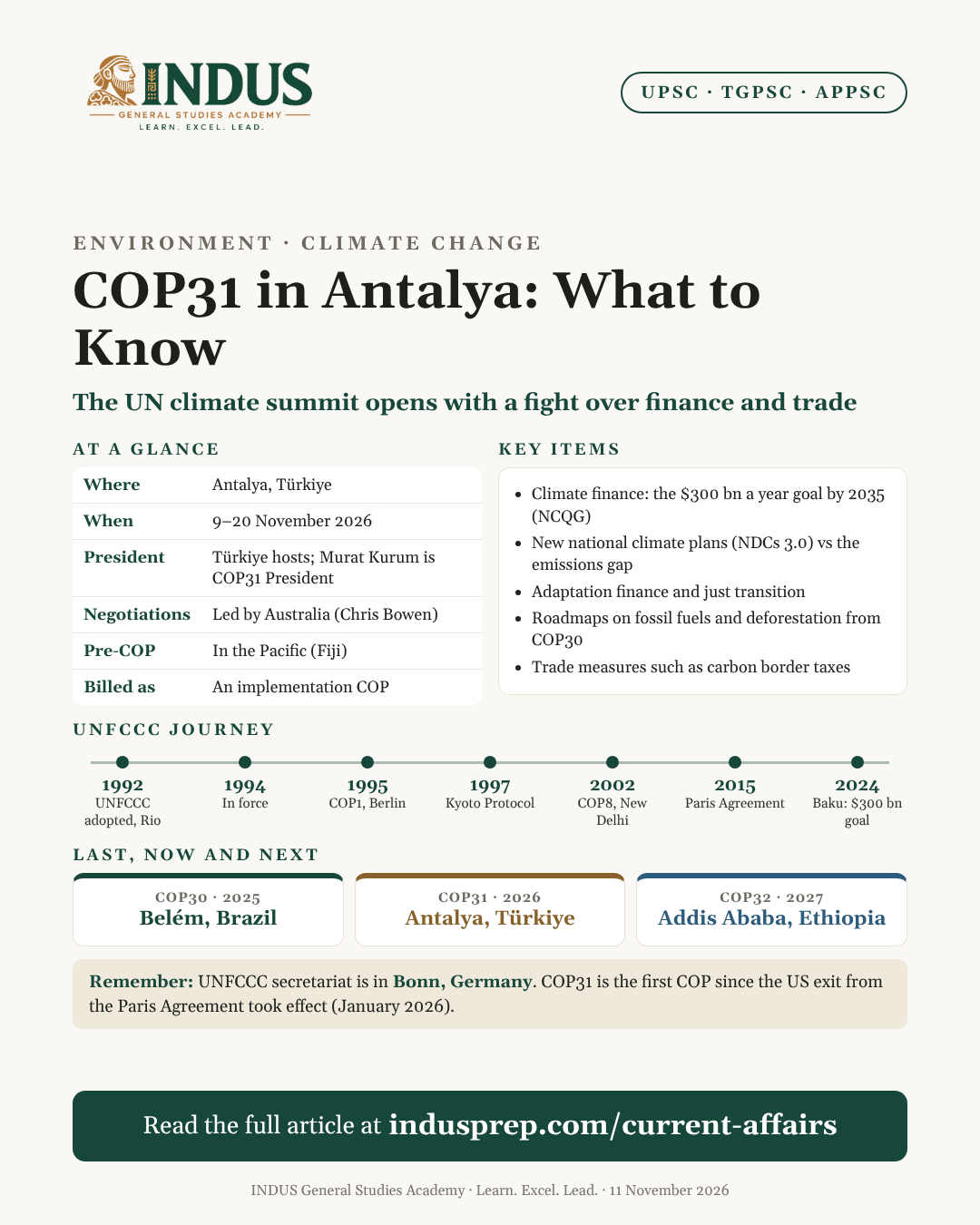
Environment
COP31 Opens in Antalya, Türkiye: Climate Finance and Trade Divide Nations
In news
- COP31, the 31st Conference of the Parties to the UNFCCC, opened in Antalya, Türkiye, on 9 November 2026. It runs till 20 November.
- The opening ceremony was delayed by over an hour due to a fight over the agenda.
- The EU and the Umbrella Group of developed countries opposed adding a work programme on climate finance and trade to the agenda.
- Developing countries, including the G77 and China, wanted both included.
- Nearly 1,00,000 delegates are expected.
- The Leaders' Summit is on 11 and 12 November, hosted by Türkiye's President Recep Tayyip Erdoğan.
A shared presidency
- Australia and Türkiye both bid for COP31. Both belong to the Western Europe and Others Group, whose turn it was to host.
- A compromise was reached at COP30 in Belém, Brazil (2025):
- Türkiye hosts the summit. Its Environment Minister Murat Kurum is the COP31 President and leads the Action Agenda.
- Australia's Climate Minister Chris Bowen is the President of Negotiations.
- A pre-COP meeting in the Pacific keeps vulnerable island nations at the centre.
- This is the first time a COP has been shared in this way.
Why COP31 matters
- It is billed as an "implementation COP". The focus is on delivering past promises, not making new ones.
- It is the first COP since the US withdrawal from the Paris Agreement took effect in January 2026.
- WMO's State of the Climate 2026 report, released on the opening day, says 2026 will be among the four warmest years on record. A strong El Niño is building.
- The backdrop: high fossil fuel prices due to the West Asian conflict, and rising energy demand from data centres.
Key issues on the table
- Climate finance:
- COP29 (Baku, 2024) set the New Collective Quantified Goal (NCQG): developed countries are to provide at least $300 billion a year by 2035.
- A wider aim is to mobilise $1.3 trillion a year from all sources.
- Developing countries say delivery is slow and mostly loans.
- NDCs 3.0: countries' new climate plans for 2035, and the gap between them and the 1.5°C goal.
- Adaptation finance and the just transition mechanism agreed at COP30.
- Roadmaps on moving away from fossil fuels and halting deforestation by 2030.
- Trade measures: developing countries, including India, oppose unilateral measures such as the EU's Carbon Border Adjustment Mechanism (CBAM).
India's position
- Common But Differentiated Responsibilities and Respective Capabilities (CBDR-RC): developed countries must lead, given their historical emissions.
- Climate finance and technology transfer are needed before developing countries can raise ambition.
- No unilateral trade barriers in the name of climate.
- India's own goals: net zero by 2070 and 50% of installed power capacity from non-fossil sources (reached in 2025).
- India has offered to host COP33 in 2028.
Static connect
- UNFCCC: adopted at the Rio Earth Summit (1992); in force from 1994; nearly 200 Parties; secretariat in Bonn, Germany.
- COP1: Berlin, 1995. India hosted COP8 in New Delhi (2002), which produced the Delhi Declaration.
- Kyoto Protocol (COP3, 1997): binding cuts for developed countries (Annex I).
- Paris Agreement (COP21, 2015): keep warming well below 2°C, aim for 1.5°C. NDCs every five years.
- Global Stocktake: the first was completed at COP28, Dubai (2023). The second will conclude at COP33 (2028).
- Loss and Damage Fund: agreed at COP27, Sharm el-Sheikh (2022).
Exam relevance: UPSC Prelims and GS-3 (Environment, Climate Change), GS-2 (International Relations); TGPSC and APPSC Groups (Environment, Current Affairs).
Get the full month in one PDF
The Current Affairs Monthly covers every important item in English and Telugu, with Group 1 points.
Browse current affairs material