
All current affairs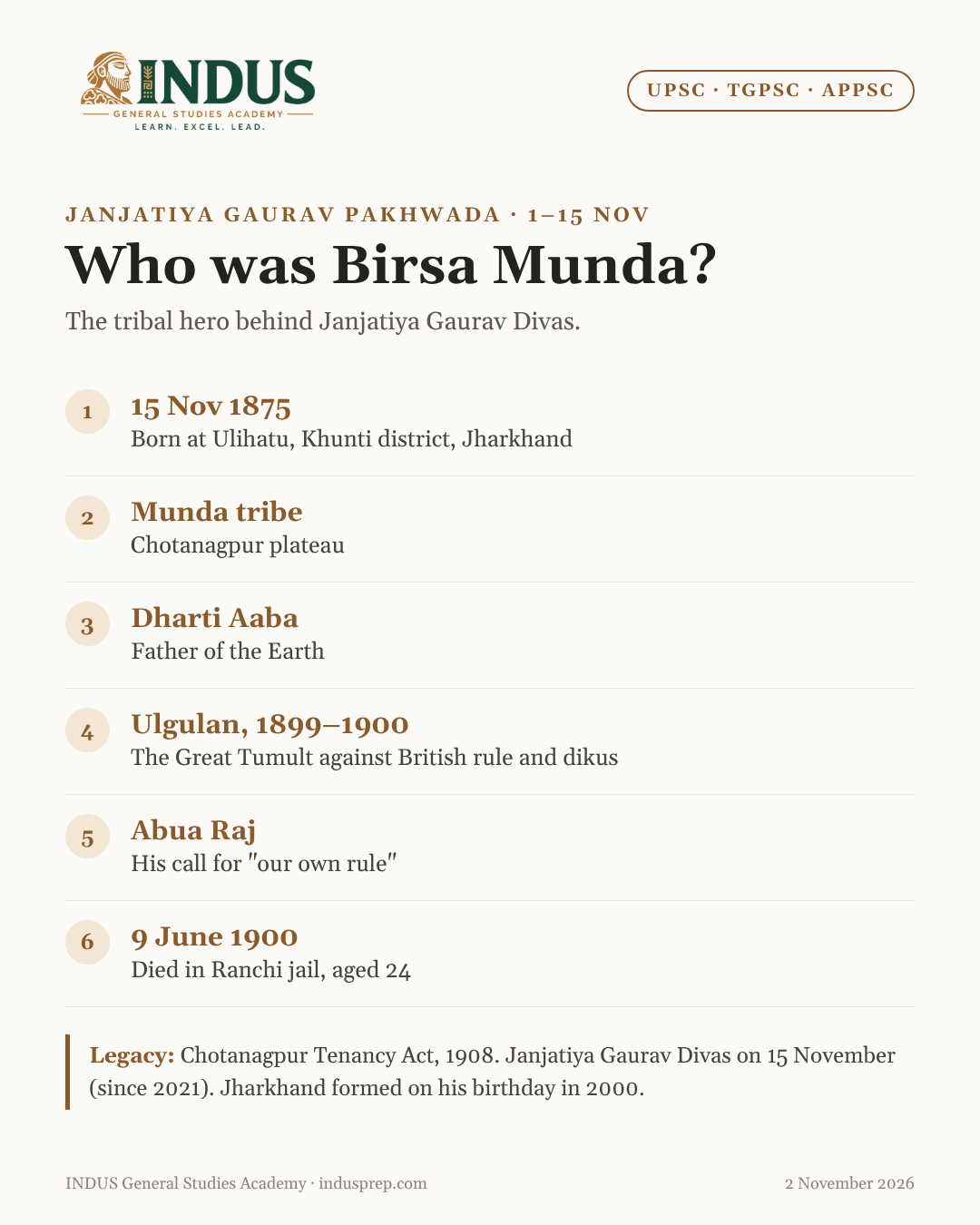
National
Janjatiya Gaurav Pakhwada: Remembering Birsa Munda, the Dharti Aaba
In news
- The Janjatiya Gaurav Pakhwada is being observed from 1 to 15 November 2026.
- It leads up to Janjatiya Gaurav Divas on 15 November, the birth anniversary of Birsa Munda.
- The fortnight celebrates the contribution of tribal communities to India's freedom struggle, culture and heritage.
About Janjatiya Gaurav Divas
- Declared by the Government of India in 2021.
- Observed every year on 15 November.
- Jharkhand was also formed on 15 November 2000, on Birsa Munda's birth anniversary.
- 2025 marked Birsa Munda's 150th birth anniversary.
Who was Birsa Munda
| Item | Detail |
|---|---|
| Born | 15 November 1875, Ulihatu (present-day Khunti district, Jharkhand) |
| Tribe | Munda |
| Region | Chotanagpur plateau |
| Title | "Dharti Aaba" (Father of the Earth) |
| Movement | Ulgulan (the Great Tumult), 1899 to 1900 |
| Died | 9 June 1900, in Ranchi jail, aged 24 |
Why the Mundas revolted
- Loss of land: the traditional Khuntkatti system of joint land ownership was breaking down.
- Dikus (outsiders): landlords, moneylenders and traders took over tribal land.
- Forced labour: the practice of beth begari (unpaid labour) was imposed on tribals.
- Colonial forest laws restricted tribal access to forests.
- Missionary activity and changes to tribal religion and customs.
The Ulgulan
- Birsa started a religious and social reform movement. His followers were called Birsaites.
- He preached against alcohol, superstition and witchcraft, and asked people to return to their traditional faith.
- The movement soon became a fight for land, forests and self-rule.
- He called for "Abua Raj" (our own rule) and an end to the Queen's rule.
- Followers attacked police stations, churches and landlords' property in 1899 and 1900.
- Birsa was arrested in February 1900 and died in jail in June 1900.
Legacy
- Chotanagpur Tenancy Act, 1908: restricted the transfer of tribal land to non-tribals. It was a direct result of the Ulgulan.
- His portrait hangs in the Central Hall of Parliament.
- Birsa Munda is a symbol of tribal identity, land rights and resistance.
Other tribal revolts to remember
| Revolt | Year | Region | Leader |
|---|---|---|---|
| Santhal Hul | 1855 to 1856 | Rajmahal Hills (Jharkhand) | Sidhu and Kanhu Murmu |
| Rampa Rebellion | 1922 to 1924 | Godavari Agency (Andhra Pradesh) | Alluri Sitarama Raju |
| Koya and Gond resistance | 1940 | Jodeghat (Telangana) | Komaram Bheem ("Jal, Jangal, Zameen") |
| Bhil Revolt | 1818 onwards | Western Ghats and Khandesh | Various leaders |
| Kol Uprising | 1831 to 1832 | Chotanagpur | Buddhu Bhagat |
Telangana and Andhra Pradesh connect
- Komaram Bheem led the Gond tribals against the Nizam's rule. His slogan was "Jal, Jangal, Zameen" (water, forest, land).
- Alluri Sitarama Raju led the Rampa Rebellion in the Godavari Agency against British forest laws.
Static connect: tribal welfare in India
- Fifth Schedule: administration of Scheduled Areas and Scheduled Tribes in most States.
- Sixth Schedule: Autonomous District Councils in Assam, Meghalaya, Tripura and Mizoram.
- Article 342: the President notifies Scheduled Tribes.
- Article 338A: the National Commission for Scheduled Tribes.
- PESA Act, 1996: self-governance through Gram Sabhas in Fifth Schedule areas.
- Forest Rights Act, 2006: individual and community rights over forest land.
- PM JANMAN (2023): development of Particularly Vulnerable Tribal Groups (PVTGs).
- Dharti Aaba Janjatiya Gram Utkarsh Abhiyan (2024): development of tribal villages, named after Birsa Munda.
Exam relevance: UPSC Prelims and GS-1 (Modern Indian History, Tribal movements); TGPSC, APPSC (History, Telangana and AP tribal movements).
Get the full month in one PDF
The Current Affairs Monthly covers every important item in English and Telugu, with Group 1 points.
Browse current affairs material