
All current affairs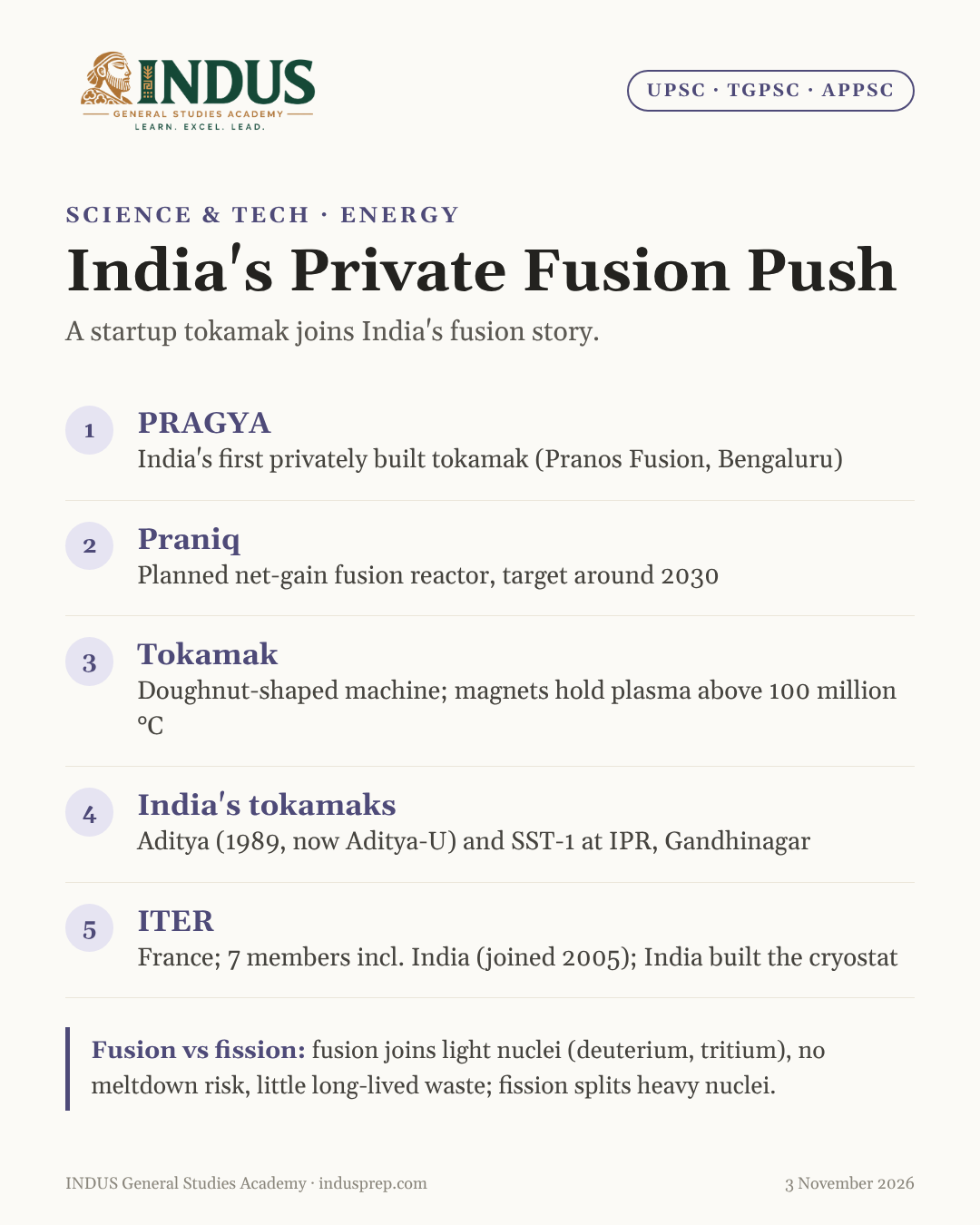
Science & Tech
India's First Private Fusion Tokamak: Pranos Fusion's PRAGYA
In news
- Pranos Fusion, a Bengaluru startup, is taking key steps towards India's first private fusion power reactor.
- It has built PRAGYA, India's first privately built tokamak.
- Its planned full-scale reactor is Praniq, targeted for around 2030, aiming to produce more energy than it consumes.
Key facts
| Item | Detail |
|---|---|
| Company | Pranos Fusion, Bengaluru (incubated at JNCASR) |
| Device | PRAGYA: a compact test tokamak |
| Purpose | Test plasma control and in-house magnets |
| Next step | Praniq: a net-gain fusion reactor (target around 2030) |
- PRAGYA heats hydrogen isotopes into plasma. It is a test bed; it does not yet produce fusion energy.
Fusion vs fission
| Fusion | Fission |
|---|---|
| Light nuclei join (hydrogen isotopes) | Heavy nuclei split (uranium, plutonium) |
| Powers the Sun and stars | Used in today's nuclear power plants |
| Fuel: deuterium (from seawater) and tritium | Fuel: uranium, thorium |
| Very little long-lived radioactive waste | Long-lived radioactive waste |
| No chain reaction, so no meltdown risk | Chain reaction must be controlled |
| Not yet commercial | Commercial since the 1950s |
What is a tokamak?
- A doughnut-shaped machine that holds plasma using strong magnetic fields.
- Plasma must reach over 100 million °C for fusion. No material can touch it, so magnets keep it away from the walls.
- Developed first in the Soviet Union in the 1950s. "Tokamak" is a Russian acronym.
India's fusion programme
- Institute for Plasma Research (IPR), Gandhinagar, under the Department of Atomic Energy.
- Aditya: India's first tokamak (1989); now upgraded as Aditya-U.
- SST-1: Steady State Superconducting Tokamak, using superconducting magnets.
ITER
- International Thermonuclear Experimental Reactor, being built at Cadarache, France.
- Seven members: EU, India, China, Japan, South Korea, Russia and the USA.
- India joined in 2005. India supplied the cryostat, ITER's largest single component.
- Full deuterium-tritium fusion is expected by 2039.
Why it matters
- Fusion promises clean, almost limitless energy with abundant fuel.
- Supports India's net zero by 2070 goal.
- Shows a growing role for private startups in strategic technology, as in space.
Challenges
- Sustaining plasma long enough to get net energy gain.
- Very high cost and long timelines.
- Tritium is scarce and must be bred inside the reactor.
- Materials that can withstand intense heat and neutron damage.
Exam relevance: UPSC Prelims, GS-3 (Science and Technology, Energy); TGPSC, APPSC (Science and Technology).
Get the full month in one PDF
The Current Affairs Monthly covers every important item in English and Telugu, with Group 1 points.
Browse current affairs material