
All current affairs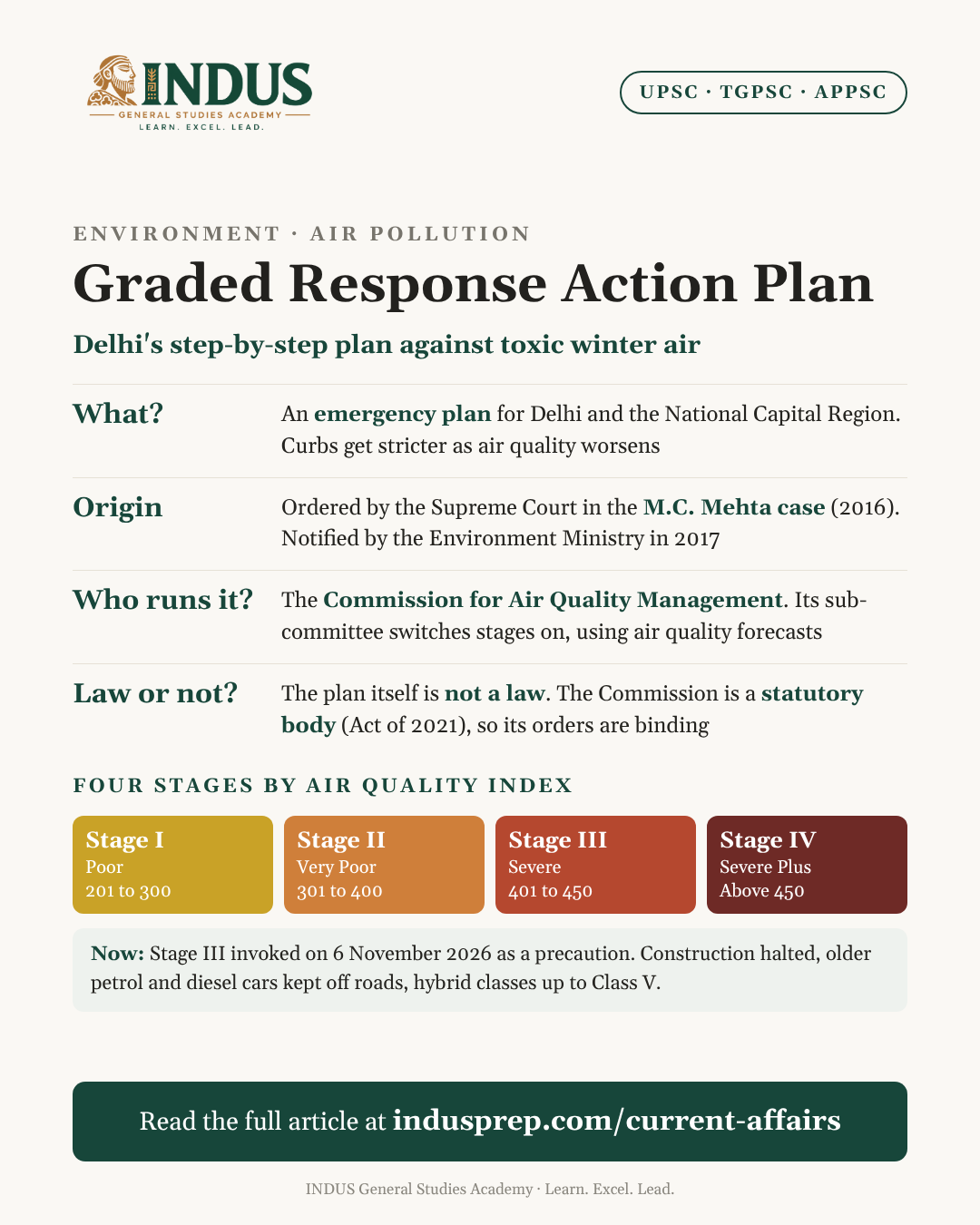
Environment
GRAP Stage III in Delhi-NCR: Curbs Return as Supreme Court Questions Their Limits
In news
- The Commission for Air Quality Management (CAQM) invoked Stage III of the Graded Response Action Plan (GRAP) across the National Capital Region (NCR) on 6 November 2026.
- Delhi's average Air Quality Index (AQI) stood at about 382, in the "very poor" range.
- The step was precautionary. Forecasts showed air quality turning "severe" between 7 and 9 November, around Diwali.
- Stage III came four days after Stage II.
- On the same day, a three-judge Bench of the Supreme Court heard the Delhi-NCR air pollution case.
What Stage III brings
Stage III actions are added to those already in force under Stages I and II.
| Area | Measure under Stage III |
|---|---|
| Construction | Ban on dust-generating construction and demolition work |
| Industry | Stone crushers and mining closed across the NCR |
| Vehicles | BS-III petrol and BS-IV diesel four-wheelers barred in Delhi and the five high-vehicle-density districts (Gurugram, Faridabad, Ghaziabad, Gautam Budh Nagar, Sonipat) |
| Goods vehicles | Entry of diesel BS-IV and older light and medium goods vehicles registered outside Delhi restricted |
| Schools | Hybrid classes (online and offline) up to Class V |
| Offices | State governments can let offices run with 50% staff on site; the rest work from home |
- Enforcement: a 50% work-from-home directive has been in force in Delhi-NCR since 5 November. Two law firms in Gurugram received show-cause notices for breaking it. This is the first use of penal provisions for such a breach.
Measures already taken this season
- Revised GRAP (September 2026): the CAQM approved a new schedule of 48 actions: 25 in Stage I, 8 in Stage II, 10 in Stage III and 5 in Stage IV.
- Earlier triggers: curbs on diesel generator sets and on BS-IV buses from other States were moved from Stage II to Stage I.
- Fewer exemptions: older goods vehicles carrying essential commodities lost their exemption in Stages III and IV.
- Wider coverage: vehicle curbs were extended to Sonipat.
- Dust monitoring: web portal-based monitoring of construction sites was extended beyond municipal limits.
- Lesson from 2025: in November 2025, the CAQM had shifted several actions to lower stages. Work from home moved from Stage IV to Stage III.
What the Supreme Court said
The Bench of Chief Justice of India Surya Kant, Justice Joymalya Bagchi and Justice V. Mohana made these points:
- Limits of restrictions: years of court orders have yielded only marginal benefits. When curbs are piled up without a scientific basis, people tend to violate them.
- Realistic goals: the Court called it "utopian" to expect a winter AQI below 100 in Delhi, as "very poor" and "severe" have become the new normal.
- Vehicles: the Court called vehicular pollution a major cause. It noted bumper-to-bumper traffic on roads linking Delhi with Ghaziabad, Noida, Gurugram and Faridabad.
- Public transport: it asked whether public transport is sufficient to reduce dependence on private cars.
- Entry points: checks at Delhi's borders cannot test a vehicle's fuel, emissions or condition.
- Stubble burning: it contributed about 14% of Delhi's pollution on 5 November. The Court suggested announcing procurement prices for crop residue in advance, so that farmers sell it instead of burning it.
- Machines for villages: crop-residue machines should go to gram panchayats, as small farmers cannot afford them.
- Equity: street vendors and daily-wage workers suffer most. In the CJI's words, "the poor people are the real sufferers".
- Diwali: awareness matters more than restrictions alone.
- Next steps: the Court will seek status and compliance reports and list the matter after the court break.
Why GRAP alone cannot clean the air
- Emergency tool, not a cure: GRAP acts after air quality falls. It does not cut emissions year-round.
- Many sources: vehicles, industry, road dust, construction dust, waste burning and stubble. Each needs its own long-term fix.
- Airshed problem: pollution crosses State borders. Delhi cannot solve it alone.
- Weather: low wind, low temperature and temperature inversion trap pollutants in winter.
- Weak enforcement: curbs work only when agencies on the ground enforce them.
- Livelihood cost: construction bans hit daily-wage workers hardest.
Way forward
- Clean transport: more electric and CNG buses, metro last-mile links and congestion pricing.
- Stubble economy: assured buyers and fixed prices for residue, and village-level machine banks.
- Year-round action: dust control, waste management and industrial fuel shifts, not only winter curbs.
- Regional planning: an airshed approach across Delhi, Haryana, Uttar Pradesh, Punjab and Rajasthan.
- Science-based rules: measure which curbs work and drop those that only add hardship.
Static connect
- GRAP: framed after the Supreme Court's order in M.C. Mehta v. Union of India (December 2016). Notified by the Environment Ministry in January 2017, based on a Central Pollution Control Board plan. It was first enforced by the Environment Pollution (Prevention and Control) Authority (EPCA), set up in 1998.
- GRAP stages (by AQI): Stage I "Poor" (201–300); Stage II "Very Poor" (301–400); Stage III "Severe" (401–450); Stage IV "Severe Plus" (above 450). Stages can be invoked in advance on the basis of forecasts.
- CAQM: a statutory body under the Commission for Air Quality Management in National Capital Region and Adjoining Areas Act, 2021. It first came through an ordinance in 2020 and replaced the EPCA. It covers the NCR and adjoining areas of Punjab, Haryana, Rajasthan and Uttar Pradesh. Its directions under Section 12 of the Act are binding.
- National AQI (2014): six categories, from "Good" (0–50) to "Severe" (401–500), based on eight pollutants.
- National Ambient Air Quality Standards (2009): cover 12 pollutants, under the Air (Prevention and Control of Pollution) Act, 1981.
- National Clean Air Programme (2019): city-level plans to cut particulate pollution.
- Constitution: the Supreme Court reads the right to clean air into Article 21. Article 48A (Directive Principle) and Article 51A(g) (Fundamental Duty) deal with protecting the environment.
Exam relevance: UPSC Prelims and GS-3 (Environment, Pollution), GS-2 (Judiciary, Statutory bodies); TGPSC, APPSC (Environment).
Get the full month in one PDF
The Current Affairs Monthly covers every important item in English and Telugu, with Group 1 points.
Browse current affairs material