
Mains Corner
Deeper Than El Niño: India's Groundwater Crisis
GS mapping: GS-1 (Water resources, Geography) | GS-3 (Agriculture, Environment, Food security) | GS-2 (Federalism, Governance) | Essay
Why in news: The 2026 monsoon ended with a 13% deficit, the largest in more than a decade. A very strong El Niño is forecast through the winter of 2026-27. Analysts warn that India's water problem is deeper than one bad monsoon: the groundwater buffer that protected farmers in past droughts is itself running down.
The paradox
For decades, groundwater was India's insurance against an unreliable monsoon. When rains failed, farmers simply pumped more.
But insurance works only if the reserve is refilled. In many States, India now draws out more groundwater than nature puts back.
- India is not facing a rainfall crisis alone. It is facing a storage and management crisis.
- The problem is not just how much it rains, but where it rains, how much is stored, and how wisely it is used.
The groundwater picture
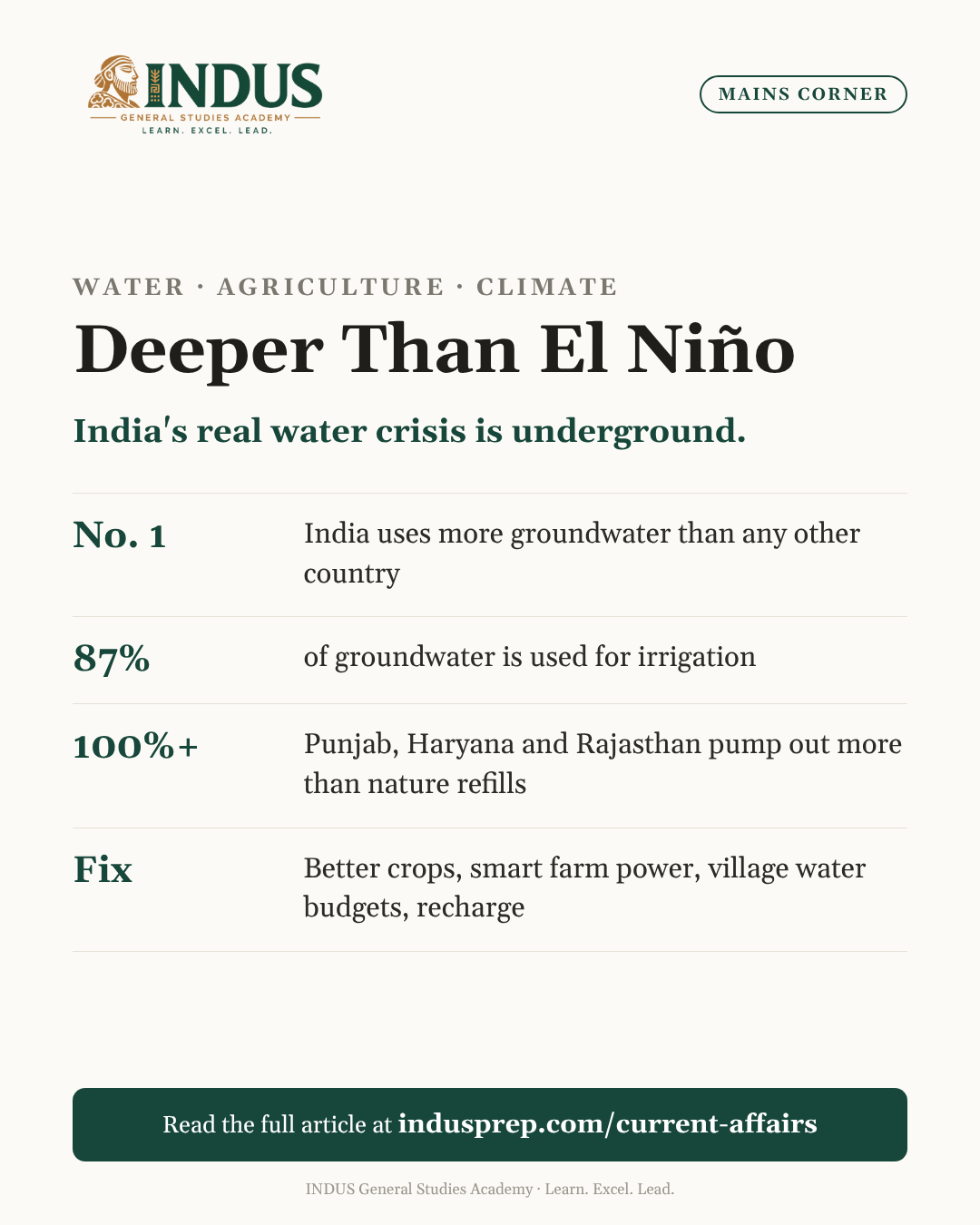
- India is the world's largest user of groundwater.
- Annual extraction: about 247 billion cubic metres (Dynamic Groundwater Resource Assessment, 2025).
- Stage of extraction: about 61% nationally, but far higher in some States.
- About 87% of groundwater is used for irrigation.
- Over-exploited units: about 11% of assessment blocks draw more than they recharge.
- Punjab, Haryana and Rajasthan extract more than 100% of their annual recharge.
- Uttar Pradesh extracts the largest volume of any State.
- Over-exploited blocks are also found in Telangana, Andhra Pradesh, Karnataka and Tamil Nadu.
- About 58% of groundwater recharge comes from rainfall. A weak monsoon cuts recharge just when extraction rises.
Why it matters
1. Food security at risk
Most of India's wheat and rice is grown with groundwater. If aquifers dry up in the "food bowl" States, national food stocks are threatened.
2. Farm distress
As water tables fall, farmers must dig deeper borewells and use bigger pumps. Costs rise, wells fail, and small farmers fall into debt.
3. Food inflation
Lower farm output pushes up food prices. Rural food inflation hits the poor the hardest.
4. Drinking water and health
Falling water tables raise fluoride, arsenic and salinity levels. This causes diseases such as fluorosis.
5. Economic growth
States that produce most of India's GDP are also among the most water-stressed. Factories, cities and data centres need water too, so competition for water will grow.
6. Climate change multiplies the risk
Erratic rainfall, heatwaves and stronger El Niño years make the monsoon less reliable. The groundwater buffer is needed more just as it is shrinking.
Root causes
- Free or cheap farm power: pumping costs almost nothing, so there is no reason to save water.
- Water-intensive crops in dry regions: paddy in Punjab and Haryana, sugarcane in Maharashtra.
- Procurement bias: assured MSP buying of rice and wheat encourages these crops.
- No limit on pumping: whoever owns land can drill a borewell, under old British-era law.
- Weak regulation: groundwater is a State subject, and enforcement is poor.
- Inefficient irrigation: flood irrigation wastes much of the water.
- Loss of recharge zones: urban concrete, encroached tanks and lakes.
Best methods adopted so far
Central schemes
- Atal Bhujal Yojana (2019): community-led groundwater management in 7 States; villages prepare water budgets and water security plans.
- Jal Shakti Abhiyan: Catch the Rain: rainwater harvesting and recharge structures across districts.
- Mission Amrit Sarovar (2022): at least 75 water bodies in every district.
- PM Krishi Sinchayee Yojana: "Per Drop More Crop": subsidy for drip and sprinkler irrigation.
- National Aquifer Mapping (NAQUIM): maps aquifers to plan their use.
- Jal Jeevan Mission: tap water to rural homes, with a focus on source sustainability.
State models
- Gujarat: Jyotigram Yojana: separate power feeders for farms; rationed farm power cut over-pumping while homes got 24-hour power.
- Punjab: Preservation of Subsoil Water Act, 2009: delayed paddy transplanting until the monsoon arrives, saving groundwater.
- Telangana: Mission Kakatiya: restored thousands of traditional tanks, improving recharge.
- Andhra Pradesh: Farmer Managed Groundwater Systems: farmers measured rainfall and water tables and planned crops together.
- Tamil Nadu: made rainwater harvesting mandatory in buildings.
- Rajasthan: Mukhyamantri Jal Swavlamban Abhiyan: village-level water conservation.
Village examples
- Hiware Bazar (Maharashtra): water budgeting, crop planning and a ban on borewells for sugarcane turned a drought village into a prosperous one.
- Ralegan Siddhi (Maharashtra): watershed development led by the community.
Way forward
- Price power, protect farmers: separate farm feeders and direct benefit transfer for power subsidies, so farmers are paid to save water.
- Crop diversification: shift away from paddy and sugarcane in water-stressed regions, with MSP and procurement for millets, pulses and oilseeds.
- Micro-irrigation at scale, especially for sugarcane and horticulture.
- Managed aquifer recharge: check dams, recharge wells and revived tanks.
- Community management: scale up the Atal Bhujal model of village water budgets.
- Legal reform: treat groundwater as a common resource, as in the Model Groundwater Bill, rather than private property tied to land.
- Data: real-time water-level monitoring and open data for farmers.
- Cities: reuse treated wastewater; protect lakes and recharge zones.
Connect the dots
| Related topic | The connection |
|---|---|
| Agriculture and MSP | Procurement bias towards rice and wheat drives water-hungry cropping |
| Power subsidies | Free farm power removes any incentive to save groundwater |
| Climate change and El Niño | Erratic monsoons increase dependence on a shrinking buffer |
| Food security and inflation | Falling output in groundwater-fed States affects national food stocks and prices |
| Urbanisation | Concrete cover and encroached lakes cut recharge in cities |
| Federalism | Water is a State subject; coordinated national action is difficult |
| Health | Deeper water brings fluoride, arsenic and salinity into drinking water |
Conclusion
El Niño will pass. Falling water tables will not, unless India changes how it uses groundwater. The answer lies not in more borewells but in better crops, smarter power policy, community management and recharge. Water security is now economic security.
Mains toolkit
Keywords for answers: groundwater depletion, stage of extraction, over-exploited blocks, water budgeting, managed aquifer recharge, crop diversification, virtual water export, tragedy of the commons, water-energy-food nexus, participatory groundwater management
Practice questions
- Groundwater, once India's insurance against monsoon failure, is itself under threat. Examine the causes of groundwater depletion in India. (150 words, 10 marks)
- Discuss how the water-energy-food nexus shapes groundwater use in India. Suggest measures, with suitable examples of successful models. (250 words, 15 marks)
Get the full month in one PDF
The Current Affairs Monthly covers every important item in English and Telugu, with Group 1 points.
Browse current affairs material