
All current affairs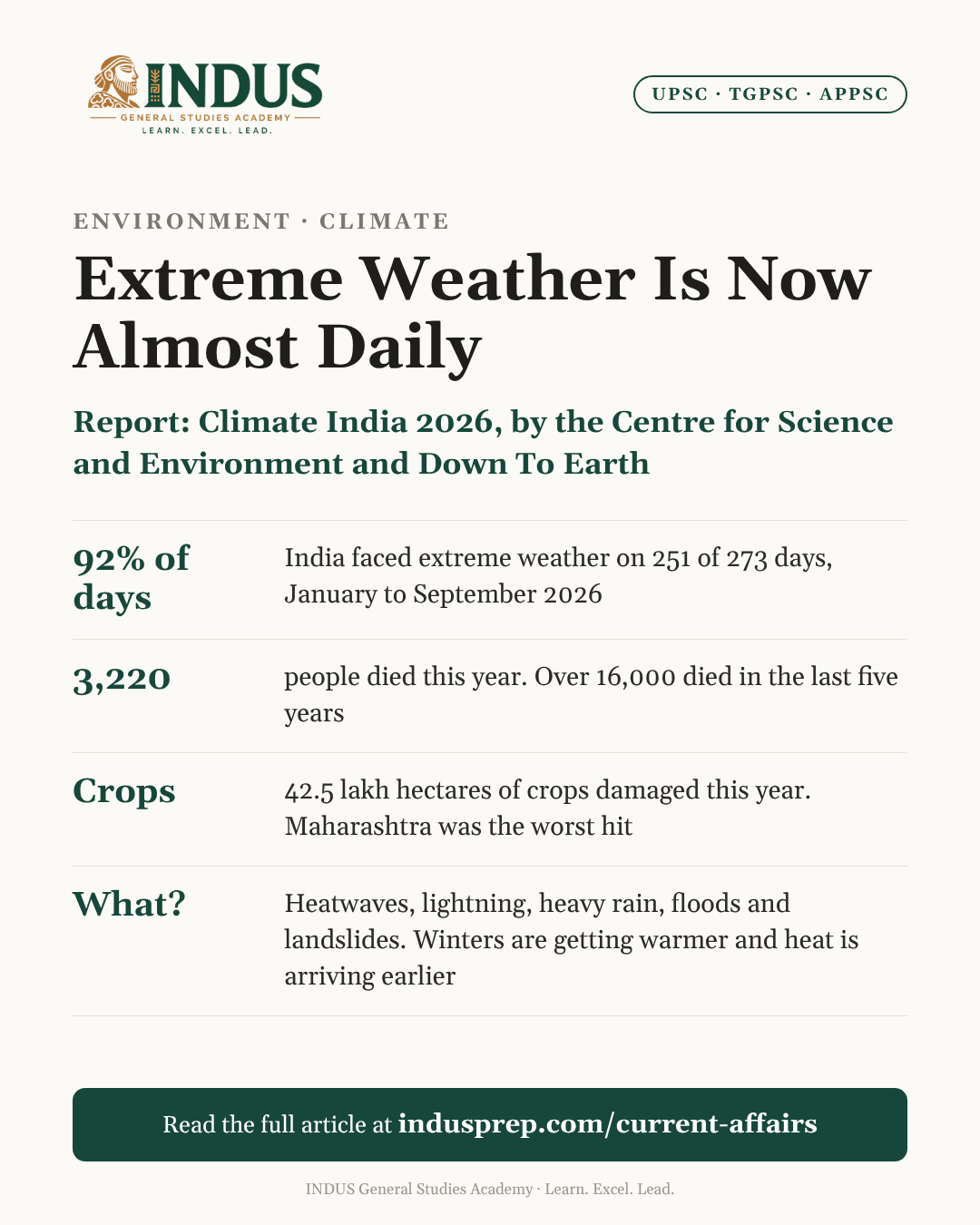
Environment
Climate India 2026: Extreme Weather on 92% of Days
In news
- The Centre for Science and Environment (CSE) and Down To Earth released "Climate India 2026: An Assessment of Extreme Weather Events" on 4 November 2026.
- It covers January to September 2026 and compares trends since 2022.
- Data sources: India Meteorological Department (IMD), the Disaster Management Division of the Union Home Ministry, and media reports.
Key findings (January–September 2026)
| Indicator | Finding |
|---|---|
| Days with extreme weather | 251 of 273 days (92%) |
| Deaths | 3,220 |
| Crop area affected | 4.25 million hectares (42.5 lakh hectares) |
| Monsoon season | Heavy rain, floods or landslides somewhere on all 122 days |
| Monsoon rainfall | 13% below the long-period average |
| February 2026 | Driest February since 1901; fourth-warmest in 125 years |
The five-year trend (2022–2026)
- More than 16,000 deaths from extreme weather in five years.
- About 65% of deaths occurred in the last three years.
- 20.6 million hectares of crops affected; over 82% of it in 2024–2026.
- Share of days with extreme weather: 86–88% (2022–23), 93% (2024), 99% (2025), 92% (2026).
- Extreme weather has become a near-daily event, not a rare one.
Where it hit hardest
- Most extreme weather days (2026): Uttar Pradesh and Himachal Pradesh, each on about 64% of days.
- Most deaths (2026): Uttar Pradesh (811), Maharashtra (286), Bihar (245).
- Most crop damage (2026): Maharashtra (2.83 million hectares).
- Region: Northwest India had extreme weather on 235 days.
Changing seasons
- Warmer winters: fewer cold waves; none in February 2026.
- Early heat: Himachal Pradesh saw a heatwave in early March. Coastal Andhra Pradesh had its earliest heatwave in five years.
- Erratic monsoon: less total rain, but more intense spells. This means both dry spells and flash floods.
Events covered
- Heatwaves and cold waves
- Lightning and thunderstorms
- Heavy rainfall, floods and landslides
- Cyclones, hailstorms, dust storms, snowfall
Why it matters
- Lives: lightning, heat and floods kill the poor and outdoor workers most.
- Food security: crop losses hit farm incomes and push up food prices.
- Economy: damage to houses, roads and power systems.
- Planning: disaster plans built for "rare" events fail when extremes become routine.
What the report suggests
- Shift from disaster response to risk reduction and resilience.
- Better urban drainage and groundwater recharge.
- Restore forests, wetlands and green spaces.
- Better early warnings that reach the last mile.
Static connect
- Extreme weather event: weather far outside normal patterns for a place and season (heatwave, cloudburst, cold wave, cyclone).
- IMD heatwave criteria: maximum temperature of at least 40°C in plains (30°C in hills), and at least 4.5°C above normal.
- Heat Action Plans: first prepared by Ahmedabad (2013); now prepared by many States and cities with NDMA guidance.
- Disaster Management Act, 2005: set up the National Disaster Management Authority (NDMA), chaired by the Prime Minister.
- National Action Plan on Climate Change (2008): eight national missions, including sustainable agriculture and water.
- Lightning: is not a "notified disaster" for central relief; several States treat it as a State-specific disaster.
Exam relevance: UPSC Prelims and GS-3 (Environment, Disaster management), GS-1 (Geography); TGPSC, APPSC (Environment, Disaster management).
Get the full month in one PDF
The Current Affairs Monthly covers every important item in English and Telugu, with Group 1 points.
Browse current affairs material