
All current affairs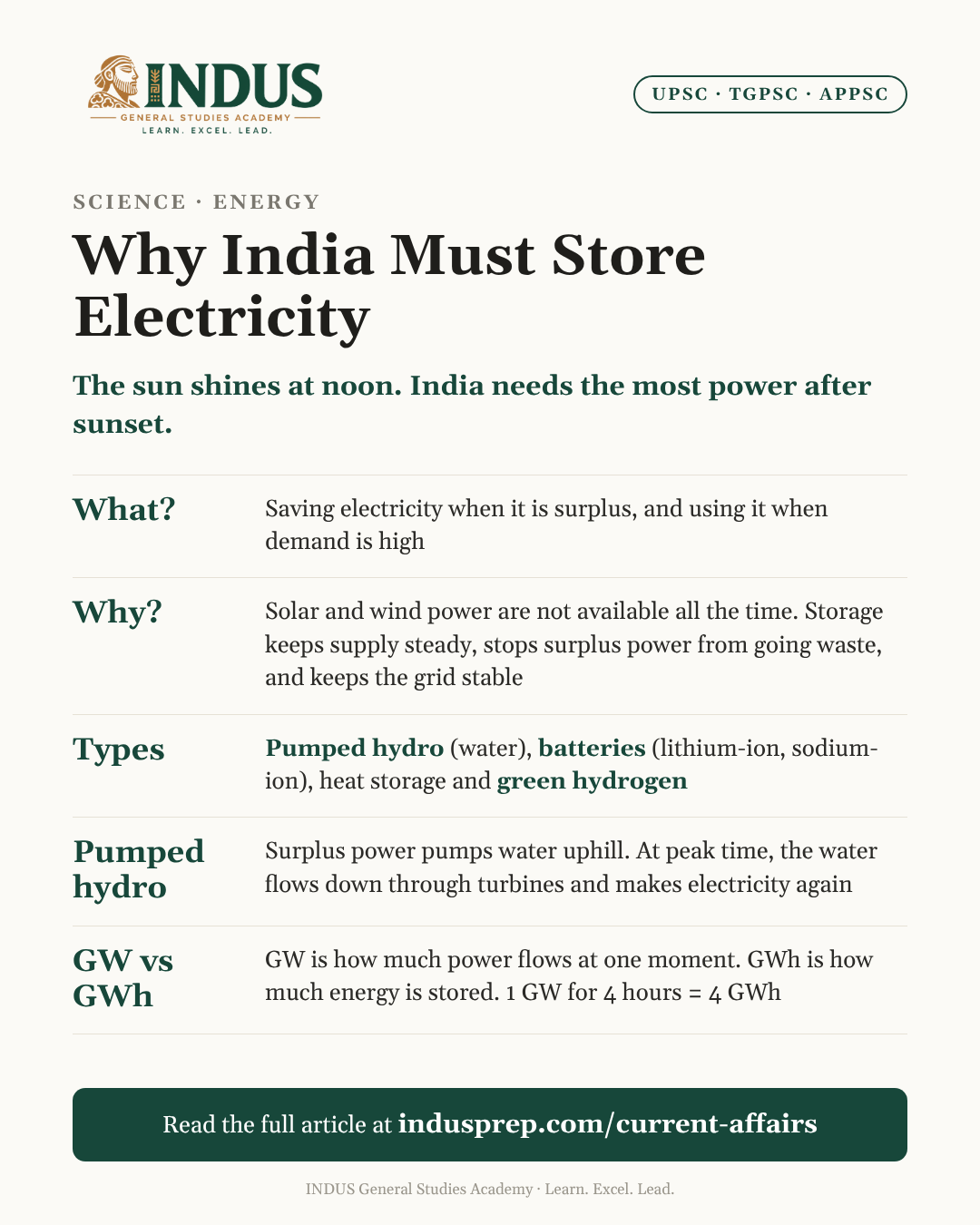
Economy
Cabinet Clears ₹14,500 Crore Scheme for 92 GWh of Energy Storage
In news
- The Union Cabinet (4 November 2026) approved Viability Gap Funding (VGF) of ₹14,500 crore for 92 GWh of grid-scale energy storage.
- Period: 2026-27 to 2030-31.
- Aim: store solar and wind power and supply it when demand peaks.
Key facts
| Item | Detail |
|---|---|
| Central support | ₹14,500 crore, as Viability Gap Funding |
| Total capacity | 92 GWh |
| Pumped Storage Projects | 60 GWh |
| Battery Energy Storage Systems | 30 GWh |
| Emerging technologies | 2 GWh |
| Expected investment | About ₹97,600 crore |
| Allocation | Tariff-based competitive bidding, with State governments |
| Domestic content | At least 40% for battery projects |
| Eligibility | Only projects not yet commissioned |
Scale of the scheme
- India's present grid-scale storage: about 54 GWh.
- The new 92 GWh is about 170% of this.
- It meets about 22% of the 411.4 GWh storage India will need by 2031-32 (Central Electricity Authority, National Electricity Plan).
What is Viability Gap Funding?
- A one-time capital grant from the government.
- It covers part of the project cost, so that a useful but costly project becomes commercially viable.
- Result: storage projects can offer lower tariffs to power distribution companies.
What is energy storage?
- It means storing electricity when it is surplus and releasing it when it is needed.
- GW vs GWh:
- GW (gigawatt) = how much power can flow at one moment.
- GWh (gigawatt-hour) = how much energy is stored in total.
- Example: a 1 GW system that runs for 4 hours stores 4 GWh.
Why India needs storage
- Solar peaks at noon. Demand peaks after sunset. Storage shifts noon power to the evening. This mismatch is called the "duck curve".
- Wind is seasonal and variable. Output changes hour to hour.
- Grid stability: the grid must stay at 50 Hz. Storage responds in seconds to balance supply and demand.
- Less waste: surplus solar is often switched off (curtailment). Storage saves it.
- Less coal at peak hours: costly thermal plants run less in the evening.
- Targets: 500 GW non-fossil capacity by 2030 and Net Zero by 2070.
Types of energy storage
| Type | Examples | How it stores energy |
|---|---|---|
| Mechanical | Pumped hydro, compressed air, flywheel | As height of water, pressure of air or spinning motion |
| Electrochemical | Lithium-ion, sodium-ion, flow batteries | As chemical energy in cells |
| Thermal | Molten salt | As heat, released later to make steam |
| Chemical | Green hydrogen | Electricity splits water; hydrogen is stored and used later |
Pumped storage vs battery storage
| Feature | Pumped Storage Project | Battery Energy Storage System |
|---|---|---|
| How it works | Surplus power pumps water to an upper reservoir; water flows down through turbines at peak time | Electricity charges battery cells; cells discharge when needed |
| Duration | Long (about 6 to 10 hours) | Short (about 2 to 4 hours) |
| Life | 40 years or more | About 10 to 15 years |
| Response | Minutes | Milliseconds |
| Build time | Long; needs hilly sites and two reservoirs | Short; can be placed almost anywhere |
| Concern | Land, forest and ecology | Import of lithium cells; battery waste |
Earlier steps
- VGF for battery storage (2023): ₹3,760 crore for 4,000 MWh.
- VGF for battery storage (2025): ₹5,400 crore for 30 GWh, through the Power System Development Fund.
- PLI for Advanced Chemistry Cell batteries (2021): ₹18,100 crore for domestic cell manufacturing.
- The new scheme is wider: it covers pumped storage and new technologies too.
Andhra Pradesh link
- Pinnapuram (Andhra Pradesh): a large integrated solar, wind and pumped storage project by Greenko. It is a model for round-the-clock renewable power.
Challenges
- Pumped storage needs suitable sites, forest clearance and long construction time.
- Battery cells and lithium are mostly imported, largely from China.
- Storage adds to the cost of power until technology becomes cheaper.
Static connect
- Central Electricity Authority (CEA): prepares the National Electricity Plan under the Electricity Act, 2003.
- Panchamrit (COP26, Glasgow, 2021): 500 GW non-fossil capacity by 2030; Net Zero by 2070.
- Updated NDC (2022): 45% cut in emissions intensity of GDP by 2030 over 2005 levels; 50% of installed power capacity from non-fossil sources by 2030 (reached in 2025, five years early).
Exam relevance: UPSC Prelims and GS-3 (Energy, Infrastructure, Environment); TGPSC, APPSC (Economy, Science and Technology).
Get the full month in one PDF
The Current Affairs Monthly covers every important item in English and Telugu, with Group 1 points.
Browse current affairs material