
Mains Corner
AI Is Changing the World. Can India Lead, Not Just Use?
GS mapping: GS-3 (Science and Technology, Indigenisation of technology, IT and computers, Economy) | GS-2 (Government policies) | Essay
Why in news: India is building its own AI models and computing capacity under the IndiaAI Mission, after hosting the AI Impact Summit in New Delhi. A recent article by a former Defence Secretary and UPSC Chairman argues that India should not copy the US model, but lead in multilingual, frugal and public-interest AI.
AI is already doing amazing things
AI is no longer just chatbots. Some recent breakthroughs:
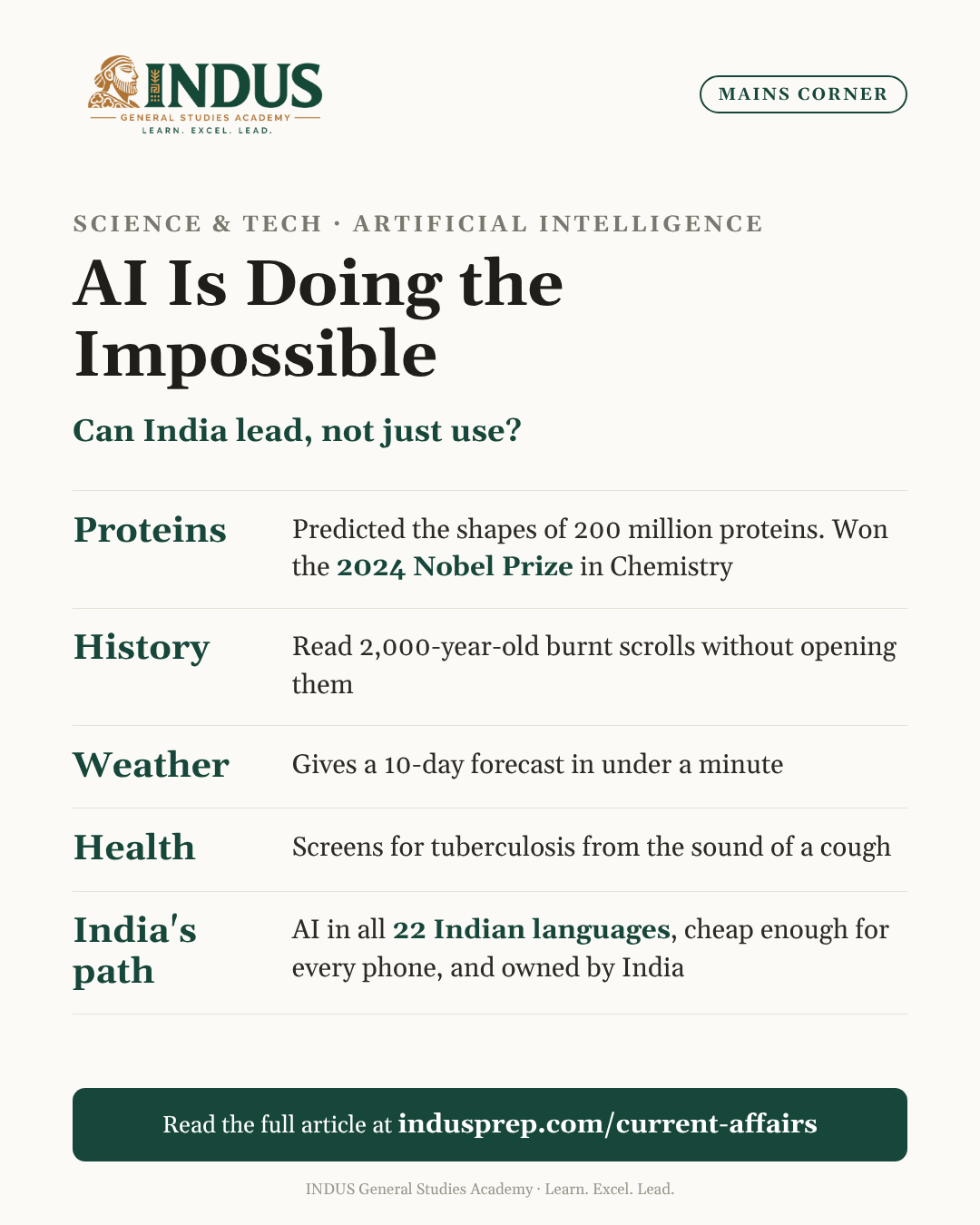
- Solving biology's 50-year puzzle: AlphaFold predicted the 3D shape of about 200 million proteins. This once took scientists years for a single protein. It won the 2024 Nobel Prize in Chemistry. Faster drug and vaccine design is now possible.
- Reading scrolls burnt 2,000 years ago: scrolls charred by the Mount Vesuvius eruption (79 CE) cannot be opened without crumbling. AI read words hidden inside from 3D scans, without unrolling them.
- New medicines from scratch: AI scanned millions of molecules and found new antibiotics against drug-resistant bacteria, in weeks instead of years.
- Weather in a minute: AI models now give 10-day forecasts in under a minute on a single computer. Traditional models need hours on supercomputers.
- Topping the Maths Olympiad: in 2025, AI systems scored at gold-medal level at the International Mathematical Olympiad.
- Driverless taxis: robotaxis now carry paying passengers in several US and Chinese cities with no driver at the wheel.
Closer home:
- TB screening from a cough: Wadhwani AI tools screen for tuberculosis using cough sounds and X-rays, in places without specialists.
- Speaking across languages: Bhashini translates speech between Indian languages in real time. A farmer can ask a question in Telugu and get an answer from a Hindi source.
- Saving elephants: the railways' Gajraj system uses AI to detect elephants near tracks and warn train drivers.
- Telangana's "Saagu Baagu": an AI-based advisory project for chilli farmers in Khammam improved yields and cut costs. It was a World Economic Forum pilot.
Where the world stands
- United States: leads in big foundation models, AI agents, AI for science and chips. Private AI investment hit about $286 billion in 2025.
- China: leads in robotics and AI research output. Models like DeepSeek showed powerful AI can be built at low cost.
- Europe: leads in regulation. The EU AI Act is the world's first comprehensive AI law.
- India: strong in language AI and applied AI, but weak in frontier research and compute.
India's strengths
- Digital Public Infrastructure: Aadhaar and UPI proved India can build at huge scale and low cost.
- Language AI: AI4Bharat, BharatGen, Sarvam AI and Bhashini cover all 22 scheduled languages.
- Applied AI: Annam.AI (IIT Ropar) for farm weather advice; Airawat Research Foundation (IIT Kanpur) for air quality.
- Compute: the IndiaAI Mission has made over 45,000 GPUs (graphics processing units) available.
- Global voice: the AI Impact Summit produced the New Delhi Declaration, endorsed by 92 countries.
How India can lead (as per the article)
Where to focus
- Multilingual, voice-first AI: open models for languages the West ignores. These can serve Africa and South and Southeast Asia.
- Frugal AI: small, cheap models that run on phones, even offline, and on low-power chips in vehicles and farm equipment.
- AI as public infrastructure: for health, farming, education and land records, where data is imperfect and accountability is critical.
- Evaluation and trust: benchmarks for Indian languages; tests for social bias; tools to detect deepfakes; safety standards for the Global South.
Six steps
- A dedicated institution: a National AI Development Organisation, like NPCI for payments. Proposed ownership: 26% government, 26% SBI and LIC, 30% IT industry, rest philanthropy and academia.
- Steady funding: ₹25,000–30,000 crore a year for a decade, focused on a few priorities.
- Open public assets: publicly funded models, datasets and benchmarks open to all. Use the Data Empowerment and Protection Architecture for consent-based data sharing. Make AIKosh and Bhashini trusted data commons.
- Government as first customer: buy Indian AI solutions to help them scale.
- Talent: 1,000 research chairs and doctoral fellowships, like the Visvesvaraya PhD Scheme; bring back Indian researchers from abroad.
- Compute and chips: shared GPU access, national supercomputing and energy-efficient AI chips through Semicon India.
The key lesson
- In semiconductors, Indian engineers designed world-class chips, but the intellectual property belonged to foreign firms.
- India must own the IP in AI.
- Red ocean vs blue ocean: racing to match the best US models is a crowded "red ocean". India's "blue ocean" is AI that speaks every language and runs on billions of everyday devices.
Challenges on the way
- Compute dependence: advanced chips are imported; export controls can block access.
- Low research spending: India spends only about 0.65% of GDP on research and development, compared with over 2.5% in China and the US.
- Brain drain: many top Indian AI researchers work abroad.
- Data gaps: digital data in most Indian languages is thin, scattered and of poor quality.
- Small private funding compared with the US and China.
- Energy and water: data centres need huge power and cooling.
- Jobs: AI may disrupt IT services, BPO and routine office work, India's big employers.
- Risks: deepfakes, misinformation, bias, privacy (DPDP Act, 2023) and cyber attacks on AI systems.
- Regulation balance: too strict hurts innovation; too loose harms citizens.
Way forward
- Fund fundamental research, not just applications.
- Universities and industry should work together on open models.
- Build Indian-language datasets as a national public good.
- Use light-touch, risk-based governance, like the India AI Governance Guidelines and CERT-In's AI security audit guidelines.
- Reskill workers for an AI economy through Skill India and FutureSkills Prime.
- Use green energy for data centres.
- Partner with the Global South to export Indian AI as public infrastructure, as with UPI.
Connect the dots
| Related theme | The connection |
|---|---|
| Digital Public Infrastructure | The UPI and Aadhaar model of open, scalable public platforms can be applied to AI |
| Semiconductor self-reliance | AI depends on chips; India's chip mission decides its AI future |
| Future of work | AI changes jobs; needs reskilling and social security |
| Data protection and privacy | AI training needs data; consent and safeguards are essential |
| Cyber security | AI systems face new threats like data poisoning and prompt injection |
| Indian languages and inclusion | Voice-first AI can reach those who cannot read or write English |
| Energy transition | Data centres raise power demand; renewables and storage must keep pace |
| Strategic autonomy | Owning technology reduces dependence on foreign powers |
Conclusion
AI is already reading lost history, designing medicines and predicting the weather. The question for India is not whether to use AI, but whether to build and own it. India's path is not to copy Silicon Valley, but to build AI for the many: in every language, on every phone, for public good. As with UPI, India can turn scale and diversity into global leadership, if it invests steadily in research, talent, compute and its own intellectual property.
Mains toolkit
Keywords for answers: foundation models, frugal AI, voice-first AI, sovereign AI, AI as public infrastructure, compute capacity, intellectual property, blue ocean strategy, Digital Public Infrastructure, responsible AI, deepfakes, brain drain
Practice questions
- "India should not race to build AI that merely matches the world's best, but AI that serves the many." Discuss. (150 words, 10 marks)
- What are the major challenges India faces in becoming a leader in artificial intelligence research? Suggest a strategy to overcome them. (250 words, 15 marks)
Get the full month in one PDF
The Current Affairs Monthly covers every important item in English and Telugu, with Group 1 points.
Browse current affairs material